
Area of Common Shapes
The area of a shape is the amount of two-dimensional space it covers. For a square, it's the space inside the four edges. For a circle, it's everything inside the boundary. Area is measured in square units (square inches, square feet, square meters, and so on) because what you're really counting is the number of unit squares that fit inside the shape.
For three-dimensional objects, the related measurement is surface area — the total area of the outside surface of the object.
A Basic Example
A rectangle 3 units wide and 4 units tall has an area of \(3 \times 4 = 12\) square units. You can verify visually: twelve 1×1 squares fit inside it exactly.
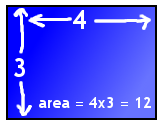
That's the core idea — area counts the number of unit squares that fit inside the shape. The formulas below are shortcuts for that count.
Square
$$\text{Area} = s^2$$
where \(s\) is the length of one side.

A square has four equal sides, so the formula is just side times side. If a side is 5 inches, the area is \(5^2 = 25\) square inches.
Rectangle
$$\text{Area} = \ell \cdot w$$
where \(\ell\) is the length and \(w\) is the width.
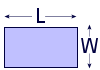
A rectangle with length 8 and width 3 has area \(8 \cdot 3 = 24\) square units. The square is really just a special case of the rectangle where length and width are equal.
Circle
$$\text{Area} = \pi r^2$$
where \(r\) is the radius (the distance from the center to the edge).

A circle with radius 5 has area \(\pi \cdot 5^2 = 25\pi \approx 78.5\) square units.
Watch out: the formula uses the radius, not the diameter. If you're given the diameter, divide by 2 first.
Triangle
$$\text{Area} = \tfrac{1}{2} \cdot b \cdot h$$
where \(b\) is the base and \(h\) is the height (the perpendicular distance from the base to the opposite vertex).
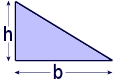
A triangle with base 6 and height 4 has area \(\tfrac{1}{2} \cdot 6 \cdot 4 = 12\) square units.
The "one half" makes sense once you notice that any triangle is half of a rectangle (or parallelogram) with the same base and height. Two copies of the triangle, one flipped, fit together to form that rectangle.
Important detail: the height must be perpendicular to the base, not the length of a slanted side. For a right triangle, the two legs already meet at 90°, so you can use them directly as base and height.
Trapezoid
$$\text{Area} = \tfrac{1}{2}(b_1 + b_2) \cdot h$$
where \(b_1\) and \(b_2\) are the lengths of the two parallel sides, and \(h\) is the perpendicular distance between them.
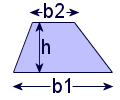
A trapezoid with parallel sides of length 6 and 10 and height 4 has area \(\tfrac{1}{2}(6 + 10) \cdot 4 = \tfrac{1}{2}(16)(4) = 32\) square units.
The intuition: a trapezoid is what you get when a triangle is "cut off" at the top. The formula averages the two parallel sides (the average length of the shape across its height) and multiplies by the height — a generalization of the rectangle formula \(\ell \cdot w\).
Practice Problems
1. A square has sides of length 9 meters. What is its area? Show answer\(9^2 = 81\) square meters.
2. A rectangle has length 12 cm and width 5 cm. What is its area? Show answer\(12 \cdot 5 = 60\) square centimeters.
3. A circle has a diameter of 10 inches. What is its area? (Leave the answer in terms of \(\pi\).) Show answerThe radius is \(10 \div 2 = 5\). Area: \(\pi \cdot 5^2 = 25\pi\) square inches.
4. A triangle has base 14 and height 6. What is its area? Show answer\(\tfrac{1}{2} \cdot 14 \cdot 6 = 42\) square units.
5. A trapezoid has parallel sides of 8 and 12, with height 5. What is its area? Show answer\(\tfrac{1}{2}(8 + 12) \cdot 5 = \tfrac{1}{2}(20)(5) = 50\) square units.
6. A square garden has an area of 64 square feet. How long is each side? Show answerSolve \(s^2 = 64\): \(s = 8\) feet.