
Points, Lines, and Planes
The Building Blocks
Everything in geometry starts with three fundamental ideas: points, lines, and planes. These are the simplest geometric objects, and every other figure is built from them. Triangles, circles, cubes, pyramids — all of them are combinations of points, lines, and planes.
What makes these three concepts special is that they're actually undefined terms. There's nothing simpler to define them in terms of. Instead, geometry describes what they are and how they behave. Think of them like the atoms of geometry: indivisible on their own, but the building blocks for everything else.
Points
A point represents a location in space. That's it. It has no size, no width, no length, no dimension — just position. You can't actually see a point because it takes up zero space, but they're drawn as dots so they can be worked with on paper.
Points are named using capital letters: point A, point B, point C, and so on. When you see a dot labeled with a letter, that letter is the point's name.
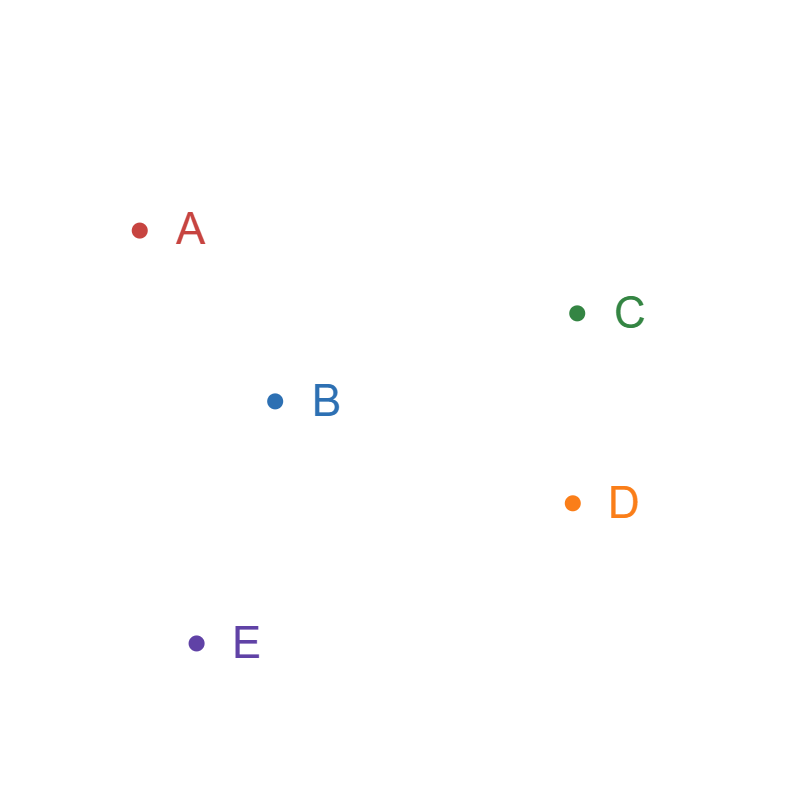
Points are everywhere once you start looking. The corner of your desk is a point. The tip of a pencil approximates one. The place where two walls meet the ceiling is a point. In coordinate geometry, every ordered pair like \((3, 5)\) represents a specific point on a grid.
Here's something important: two different points can't occupy the exact same location. If they did, they'd be the same point. Each point has its own unique position in space.
Lines
A line is a straight path that extends infinitely in both directions. Unlike a point, which has no dimensions at all, a line is one-dimensional: it has length (infinite length, in fact) but no width or thickness.
A line drawn on paper has arrows on both ends to show that it continues forever. Nothing in real life is actually infinite, but in geometry, lines don't stop.
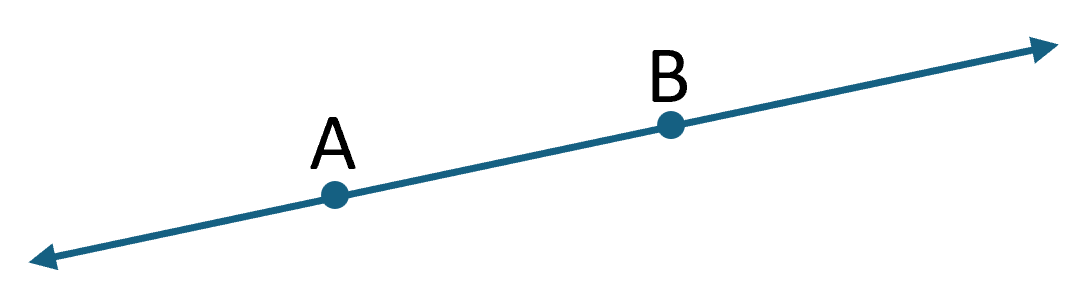
Lines can be named a few different ways. The most common method is to pick any two points on the line and write their names with a double-arrow line symbol on top. If points A and B are on a line, that line is \(\overleftrightarrow{AB}\) (read as "line AB"). You could just as easily call it \(\overleftrightarrow{BA}\) — the order doesn't matter.
Sometimes lines are named with a single lowercase letter, like "line m" or "line ℓ." This is handy when no specific points are being referenced or when multiple lines appear in a diagram.
Two important facts about lines: first, any two points determine exactly one line — given points A and B, there's only one straight line through both of them. Second, a line contains infinitely many points; the few dots usually drawn on a line are just labels for specific locations.
Planes
A plane is a flat surface that extends infinitely in all directions. A point is zero-dimensional, a line is one-dimensional, and a plane is two-dimensional: it has length and width but no thickness.
Picture a plane as an infinitely large, perfectly flat sheet of paper, or the surface of a calm lake extending in every direction. The floor of a room approximates a plane, except that it stops at the walls. A geometric plane doesn't stop.
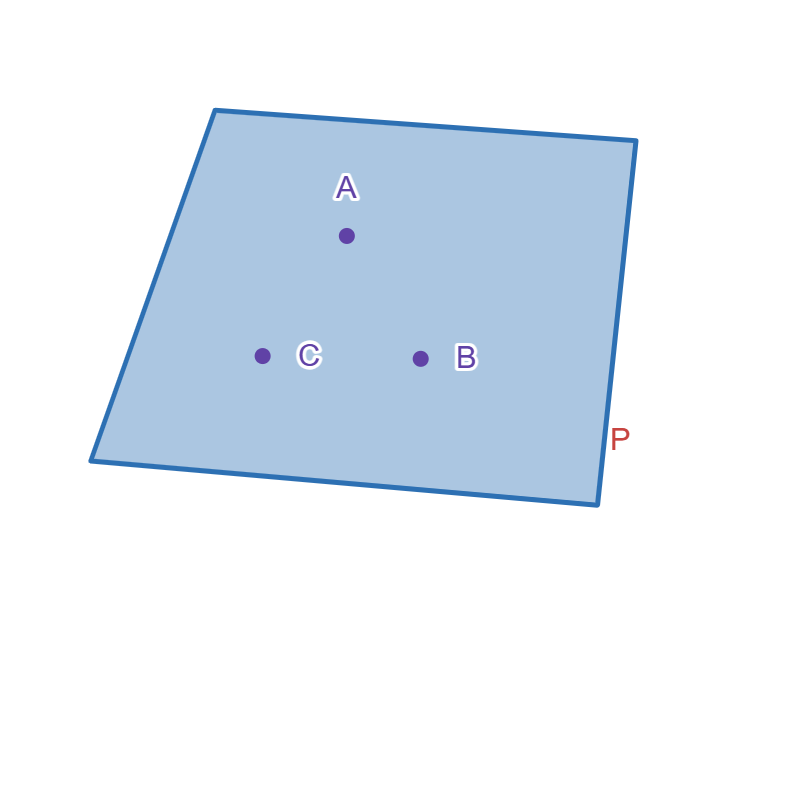
Planes are usually drawn as parallelograms (or other four-sided shapes), even though the actual plane extends well beyond the edges of the drawing. In the diagram above, plane P contains three points (A, B, and C) and a line passing through some of them. Planes are named using a single capital letter placed in a corner of the figure, like "plane P" or "plane M."
A plane can also be named using three points that lie in it (and aren't all on the same line). For example, if points A, B, and C are in a plane but don't all fall on the same line, the plane could be called "plane ABC."
Just like with points and lines, any three points that aren't all on the same line determine exactly one plane. Think about a three-legged stool: those three points of contact with the floor define a plane, which is why the stool won't wobble — unlike a four-legged table, which can rock if its legs aren't perfectly even.
Line Segments and Rays
Once lines make sense, two related concepts come up constantly: line segments and rays.
Line Segments
A line segment is the part of a line between two points, including those two points. Unlike a line, which goes on forever, a line segment has a definite beginning and end. The two endpoints define where the segment starts and stops.

A line segment is written using its two endpoints with a bar on top: \(\overline{AB}\) (read as "segment AB" or "line segment AB"). The segment includes point A, point B, and every point between them on the straight path from A to B.
Line segments are everywhere. The sides of a rectangle are line segments. The straight-line distance between your house and school on a map is the length of a line segment.
The length of a line segment is the distance between its endpoints — a number that can be measured. If \(\overline{AB}\) has a length of 5 inches, that's written \(AB = 5\) (note: no bar on top when referring to length, just the letters).
Rays
A ray is like a line that has been cut in half. It has one endpoint and then extends infinitely in one direction.
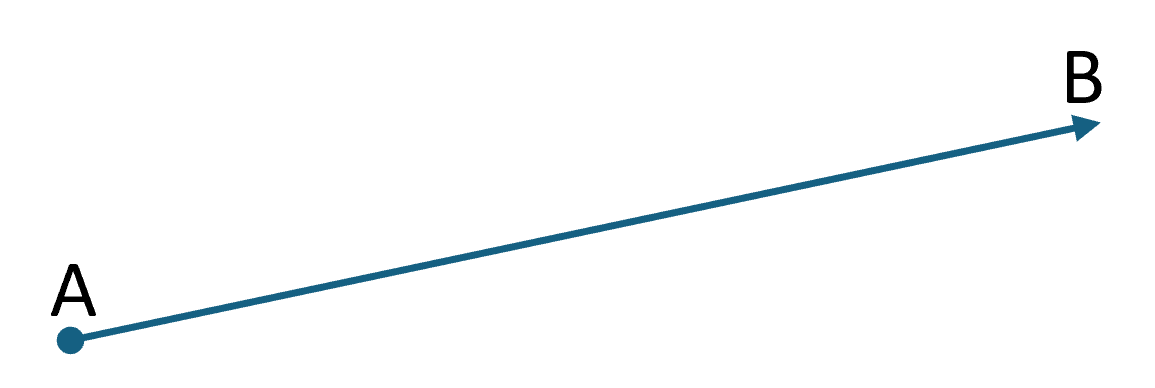
Think of a ray as a beam of light from a flashlight: it starts at the bulb and goes on forever in one direction. Rays are named using two points, with the endpoint first and any other point on the ray second. The notation is \(\overrightarrow{AB}\) (read as "ray AB"), meaning the ray starts at A, passes through B, and continues forever beyond B.
Order matters here. \(\overrightarrow{AB}\) and \(\overrightarrow{BA}\) are different rays — they have different endpoints and point in opposite directions.
Opposite Rays
Two rays are called opposite rays if they share the same endpoint and together form a straight line. If point B is between points A and C on a line, then \(\overrightarrow{BA}\) and \(\overrightarrow{BC}\) are opposite rays.
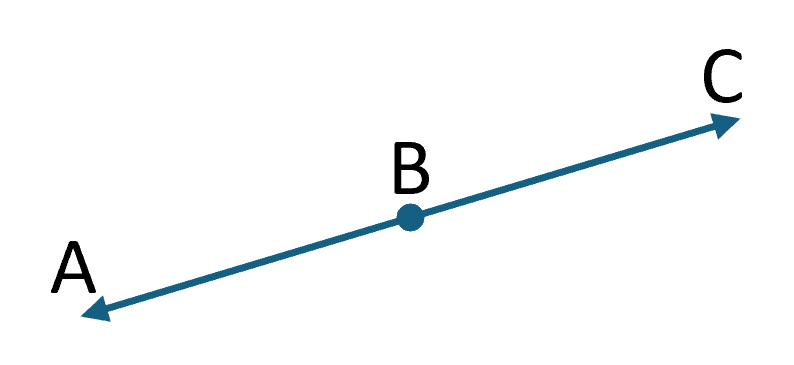
Opposite rays form a straight angle, which measures \(180°\). In the diagram, ray BA and ray BC share endpoint B (shown in red) and extend in opposite directions along the same line. More on angles in the angles lesson.
Naming Conventions
The notation matters, because the same two letters can mean different things depending on the symbol on top:
- Point A: just the letter, no symbols needed.
- \(\overleftrightarrow{AB}\) (line AB): two points with a double-arrow on top. The line passes through A and B and extends forever in both directions.
- \(\overline{AB}\) (segment AB): two points with a bar (no arrows). The segment starts at A and ends at B.
- \(\overrightarrow{AB}\) (ray AB): two points with an arrow on one end only. The ray starts at A, goes through B, and continues forever beyond B.
- Length AB or \(AB\): just the letters with no symbol on top — a number representing the distance between A and B.
Getting these right matters because \(\overleftrightarrow{AB}\), \(\overline{AB}\), and \(\overrightarrow{AB}\) all describe different objects. If a problem asks you to name a line segment and you write the wrong symbol, your answer is technically wrong even if your intent was correct.
Relationships Between Points
With the basic vocabulary in hand, you can describe how points relate to each other and to lines and planes.
Collinear Points
Points are collinear if they all lie on the same line. If a single straight line can be drawn through all the points, they're collinear.
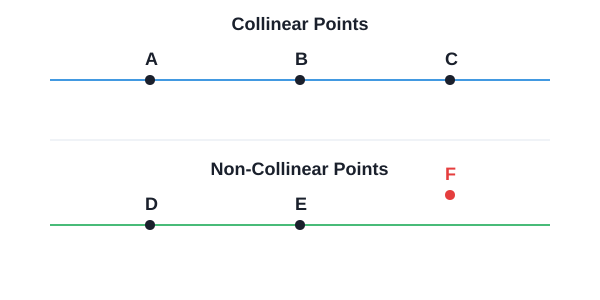
For example, if points A, B, and C all lie on \(\overleftrightarrow{AB}\), they're collinear (top of the diagram). If a point sits off to the side, like point F in the bottom diagram, those points are not all collinear.
It takes at least three points to talk about collinearity meaningfully, since any two points are automatically collinear — two points always determine a single line.
Coplanar Points
Points are coplanar if they all lie in the same plane. If all the points fit on a single flat surface, they're coplanar.

Any two or three points are always coplanar — you can always find a plane that contains them. In the diagram, points A, B, C, and D all lie in plane P, so they're coplanar. But point E (shown in red) sits outside the plane, so all five points together are not coplanar. Once you have four or more points, they might not all fit in the same plane. Imagine three points on your desk and a fourth point on the ceiling: those four points are not coplanar.
Intersections
When two lines meet, they intersect at a point, called the point of intersection. Two distinct lines can intersect at most once — if they shared two points, they'd be the same line.
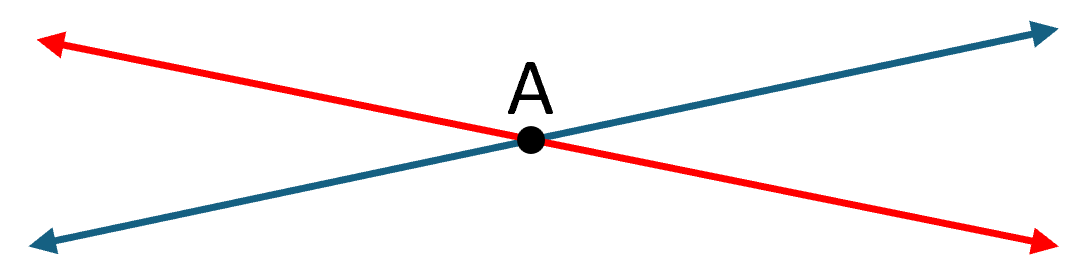
A line and a plane can intersect at a point (the line pokes through the plane), or the line can lie entirely within the plane. Two planes can intersect along an entire line — think about two walls in a room meeting along a vertical line at the corner.
Putting It Together
These terms might seem abstract, but they're the foundation of everything else in geometry. Once points, lines, planes, segments, and rays are clear, the next stops are angles, triangles, circles, and other shapes.
The key is to think of these as idealized versions of things you see every day. A star in the night sky looks like a point. The edge of a ruler is like a line segment. The surface of a table is like a plane. Geometry takes these everyday ideas and makes them precise so they can be reasoned about mathematically.
As you work through more geometry, this vocabulary comes up constantly: whether points are collinear, whether lines intersect, whether figures lie in the same plane. The notation lets you communicate clearly about exactly which object you mean. The more comfortable you become with it, the easier everything else gets.
Certain diagrams created with Desmos Geometry.