
Using the FOIL Method to Multiply Binomials
You already know how to expand something like \(7(4x + 3)\) — just use the distributive property to multiply 7 times each term inside the parentheses, giving you \(28x + 21\). But what do you do with something like \((4x + 6)(x + 2)\), where both factors are binomials?
That's where FOIL comes in. FOIL stands for First, Outside, Inside, Last — it's a way of remembering which terms to multiply together so you don't miss any.
Working Through an Example
Let's multiply \((4x + 6)(x + 2)\) step by step.
First — multiply the first term in each set of parentheses:
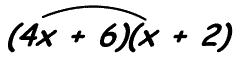
$$4x \cdot x = 4x^2$$
Outside — multiply the two outermost terms:
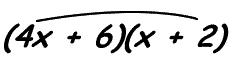
$$4x \cdot 2 = 8x$$
Inside — multiply the two innermost terms:
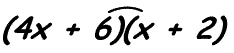
$$6 \cdot x = 6x$$
Last — multiply the last term in each set of parentheses:
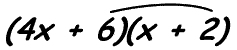
$$6 \cdot 2 = 12$$
Now add all four results together and combine like terms:
$$4x^2 + 8x + 6x + 12 = 4x^2 + 14x + 12$$
When Negatives Are Involved
Once you have the basic steps down, the most common place to go wrong is signs. Let's try \((2x - 5)(x - 4)\). The process is identical — just be deliberate about carrying the negative signs through each step:
- First: \(2x \cdot x = 2x^2\)
- Outside: \(2x \cdot (-4) = -8x\)
- Inside: \(-5 \cdot x = -5x\)
- Last: \((-5) \cdot (-4) = 20\) — two negatives make a positive
$$2x^2 - 8x - 5x + 20 = 2x^2 - 13x + 20$$
Here's another: \((6x + 1)(2x + 9)\). This one has larger coefficients but no sign trouble:
- First: \(6x \cdot 2x = 12x^2\)
- Outside: \(6x \cdot 9 = 54x\)
- Inside: \(1 \cdot 2x = 2x\)
- Last: \(1 \cdot 9 = 9\)
$$12x^2 + 56x + 9$$
A Pattern Worth Noticing
Try multiplying \((x + 4)(x - 4)\) — same number, opposite signs:
- First: \(x^2\)
- Outside: \(-4x\)
- Inside: \(4x\)
- Last: \(-16\)
The outside and inside terms cancel each other out, leaving \(x^2 - 16\). This happens any time you multiply the form \((a + b)(a - b)\) — you always get \(a^2 - b^2\). It's called the difference of squares, and it comes up constantly when you start factoring, so it's worth recognizing now.
Three or More Binomials
FOIL only applies directly to two binomials. If you need to multiply something like \((4x + 6)(5x - 3)(15 - x)\), use FOIL on any two of them first, then distribute the result onto the third. Just take it one pair at a time.