
Vertical Angles
When two lines intersect, they form four angles. The two pairs of angles directly across from each other (sharing the same vertex but on opposite sides) are called vertical angles. They have one defining property: vertical angles are always congruent (equal in measure).
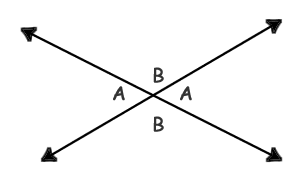
In the diagram, the two angles labeled A are vertical angles, and so are the two labeled B. No matter how the lines are oriented, \(A = A\) and \(B = B\).
Why Vertical Angles Are Equal
This isn't just a rule to memorize. It follows directly from the supplementary angle relationship: two angles that form a straight line sum to 180°.
Call the four angles \(\angle 1, \angle 2, \angle 3, \angle 4\) going around the intersection. Angles 1 and 2 are supplementary: \(\angle 1 + \angle 2 = 180°\). Angles 2 and 3 are also supplementary: \(\angle 2 + \angle 3 = 180°\).
Both expressions equal 180°, so they equal each other:
$$\angle 1 + \angle 2 = \angle 2 + \angle 3$$
Subtract \(\angle 2\) from both sides:
$$\angle 1 = \angle 3$$
Angles 1 and 3 are vertical angles — and they're equal. The same argument applies to angles 2 and 4.
Finding Unknown Angles
Vertical angles are most useful in problems where two lines intersect and you need to find angles that aren't directly given.
Example 1
Two lines intersect. One angle measures 65°. Find the other three angles.
The angle directly opposite (its vertical angle) also measures 65°.
The two remaining angles are supplementary to 65°: \(180° - 65° = 115°\). Both measure 115°.
So the four angles are 65°, 115°, 65°, 115° — alternating around the intersection.
Example 2
Two lines intersect. One angle is labeled \(3x + 10\) and its vertical angle is labeled \(5x - 30\). Find \(x\) and both angle measures.
Vertical angles are equal, so:
$$3x + 10 = 5x - 30$$ $$40 = 2x$$ $$x = 20$$
The angle measure is \(3(20) + 10 = 70°\). Both vertical angles measure 70°, and the supplementary angles each measure 110°.
Practice Problems
1. Two lines intersect and one angle measures 42°. What are the measures of the other three angles? Show answerThe vertical angle is 42°. The two supplementary angles are \(180° - 42° = \textbf{138°}\) each.
2. Two lines intersect. One angle measures \(2x + 15\) and its vertical angle measures \(4x - 25\). Find \(x\) and the angle measure. Show answerSet equal: \(2x + 15 = 4x - 25 \implies 40 = 2x \implies x = 20\). Angle measure: \(2(20) + 15 = \textbf{55°}\).
3. Two lines intersect. One angle is \(x + 30\) and an adjacent angle (not its vertical angle) is \(2x\). Find all four angles. Show answerAdjacent angles are supplementary: \(x + 30 + 2x = 180 \implies 3x = 150 \implies x = 50\). The angles are \(80°, 100°, 80°, 100°\).
4. Can two vertical angles be supplementary to each other? If so, what would their measures be? Show answerYes — if the vertical angles are equal AND they sum to 180°, then each must measure 90°. This happens when the two lines are perpendicular.