Isolating a variable

texasaggie0004

New member
Joined
May 30, 2024
Messages
10
To whom it may concern,

It's been forever since I learned trig and I've not used it sense.

I'm trying to isolate "x" in terms of "y" from the following: y=x*arcsin(x/4)

and y=x(2*arcsin(x/4)-sin(2*arcsin(x/4)))

Thanks!
 
To whom it may concern,

It's been forever since I learned trig and I've not used it sense.

I'm trying to isolate "x" in terms of "y" from the following: y=x*arcsin(x/4)

and y=x(2*arcsin(x/4)-sin(2*arcsin(x/4)))

Thanks!
I'm trying to isolate "x" in terms of "y" from the following: y=x*arcsin(x/4)

In the equation above x and y are already isolated.

May be your question is:

express y as a function x and relevant constants while y=x*arcsin(x/4)
 
Last edited:
To whom it may concern,

It's been forever since I learned trig and I've not used it sense.

I'm trying to isolate "x" in terms of "y" from the following: y=x*arcsin(x/4)

and y=x(2*arcsin(x/4)-sin(2*arcsin(x/4)))

Thanks!
I think you want to solve for x in terms of y. Am I right? But given a pair of equations in two variables, typically you will solve for specific values of each variable (that is, x = this and y = that), rather than y = f(x). Perhaps you will need to tell us where the equations came from.

When I see x both inside and outside a transcendental function, as in y=x*arcsin(x/4), I expect algebra not to work too well (though it might). Algebra can't do everything.

My first thought here is to temporarily define a third variable, z = arcsin(x/4), just to hide that function. Then the system becomes

y = xz​
y = x(2z - sin(2z))​

That doesn't help a lot, but it does make it easy to see that y can be eliminated by setting the two expressions equal, so we have to solve

xz = x(2z - sin(2z))​

Subtracting xz from both sides and simplifying, we find that

x(z - sin(2z)) = 0​

Ah! This tells you that either x must have a particular value, or z must have a particular value (which can be solved for x). I think the latter can only be solved numerically -- the difficulty actually lies with that sine, not the arcsin!

There are probably quicker ways to approach it, but this is my train of thought.

 
Thanks for the responses.

I don't know proper terminology but yes, I was hoping for an expression that has a single "X" on the "X" side of = and all the "guts" of the equation with NO "X's" and however many "Y"s all on the "Y" side of the =.

Thanks.
 
I don't know proper terminology but yes, I was hoping for an expression that has a single "X" on the "X" side of = and all the "guts" of the equation with NO "X's" and however many "Y"s all on the "Y" side of the =.

Do you understand that that will not happen?

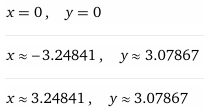
Wolfram Alpha gives three solutions:

1771596180817.png

1771596143345.png
 
Obviously I don't understand that will not happen which is probably why I'm asking on this forum that calls itself "free math help".

You see, I was pretty clear early on in my very original post that I haven't used trigonometric functions since I learned them years ago. So I was pretty clear that I'm out of practice.

You see, I can manage to recall is that with something *simple* like Y = 2x^2 + x there is a way to get a single x on the "x" side

(-1 ± √(1+8y))/4 = x

But, as I felt I was pretty clear about not knowing trigonometric functions like sin and arcsin, etc and if/how they can be jockeyed back and forth across the "=", I popped on here hoping for some guidance.

You started to answer by mentioning "When I see x both inside and outside a transcendental function, as in y=x*arcsin(x/4), I expect algebra not to work too well (though it might). Algebra can't do everything." and "I think the latter can only be solved numerically -- the difficulty actually lies with that sine, not the arcsin!"

Which was probably good enough. I responded to clarify what I was asking about. Then you responded with "Do you not understand that will not happen?" Seems like there wasn't much explanation for why it wouldn't happen beyond "I think the latter can only be solved numerically".

I'm really not curious what the actual x & y values are because popping the original equations in a graphing calculator shows there is a wide range of solutions from which I can get approximate values - I'm more curious if the expression can be rewritten with a single X by itself on one side of the equation. The answer would seem to be "no, you can't". And that's fine. I can live with approximate values from a graph.
 
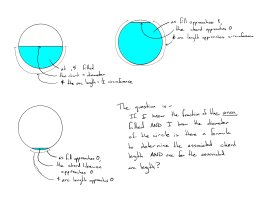
Let me try to re-word the question, please see attached image.

I know the radius of a circle. I also know how much of the area of the circle that will be filled. I'm trying to derive a formula that will tell me how much of the circumference is in contact with the filled area (an arc length) and how long the line is that divides filled from unfilled (a chord length). All the formulas I've found so far require me to calculate the angle created by the center of the circle and the two points where the chord touches the circumference (another thing I can't figure out how to determine without approximations).

And even then, the formulas I've found - only tell me how to find the percentage filled from the angle. In which case that's backwards - I know the percentage filled - I don't know the other information.

Hence my original question above.

Thanks for your patience!
 

Attachments

  • Untitled-1.jpg
    Untitled-1.jpg
    621 KB · Views: 4
Okay, so we did need to back up to the original problem, as I initially suggested. Good.

It happens that I have written a page that answers your question, and many more:
Your question is case 15, where you are given radius r and area K, and want to find arc s and chord c. It explains that you have to solve for the angle by a numerical method (Newton's method is explained there), and can then find the rest.

There is also software you could use to do the numerical solution for you.

There will probably be more that you need help with, as that is fairly dense material. Let me know if you have questions.
 
Top