
prismatic bars

logistic_guy

Senior Member
Joined
Apr 17, 2024
Messages
2,213
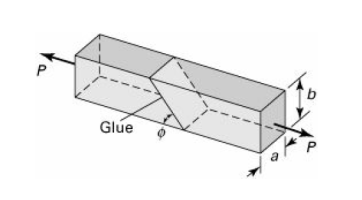
Two prismatic bars of \(\displaystyle a\) by \(\displaystyle b\) rectangular cross section are glued as shown in the figure. The allowable normal and shearing stresses for the glued joint are \(\displaystyle 700\) and \(\displaystyle 560 \ \text{kPa}\), respectively. Assuming that the strength of the joint controls the design, what is the largest axial load \(\displaystyle P\) that may be applied? Use \(\displaystyle \varphi = 40^{\circ}\), \(\displaystyle a = 50 \ \text{mm}\), and \(\displaystyle b = 75 \ \text{mm}\).
prismatic_bar.png
 
The idea of this exercise is to calculate the axial load \(\displaystyle P\) using two different equations. They will yield different results. The largest axial load \(\displaystyle P\) is the samller value of the two.

A little knowledge in tensor transformation and geometry/trigonometry will be very useful to understand the formulas that we will be using.

👍👍
 
Let \(\displaystyle \sigma_{x'}\) and \(\displaystyle \gamma_{x'y'}\) be the normal and shearing stresses for the glued joint, respectively.

By tensor transformation, we can write the stress \(\displaystyle \sigma_{x'}\) in terms of \(\displaystyle \sigma_{x}\) where \(\displaystyle \sigma_{x}\) is the normal stress along the \(\displaystyle x\)-axis or along the axial load \(\displaystyle P\).

\(\displaystyle \sigma_{x'} = \sigma_{x}\cos^2 \theta\)
 
I am sure that you are very good in geometry. And you have realized the relationship between \(\displaystyle \phi\) and \(\displaystyle \theta\).

The first angle is between the negative \(\displaystyle x\)-axis and the glue surface while the second angle is between the positive \(\displaystyle x\)-axis and the direction of \(\displaystyle \sigma_{x'}\) which is perpendicular to the glue surface.

Making a sketch and playing around, we find that:

\(\displaystyle \phi + \theta = 90^{\circ}\)
 
Top