
supported beam

logistic_guy

Senior Member
Joined
Apr 17, 2024
Messages
2,213
A simply supported beam constructed of a \(\displaystyle 0.15 \times 0.15 \times 0.015 \ \text{m}\) angle is loaded by concentrated force \(\displaystyle P = 22.5 \ \text{kN}\) at its midspan. Calculate stress \(\displaystyle \sigma_x\) at \(\displaystyle A\) and the orientation of the neutral axis. Neglect the effect of shear in bending and assume that beam twisting is prevented.
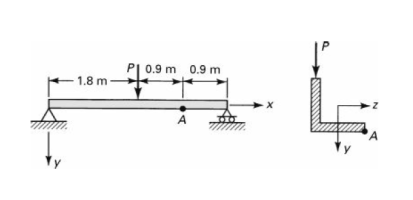
supported_beam.png
 
This is the most difficult problem of all, so if we solve it, we can solve all of them!

To give you a taste of how complex the formula of the stress, we start by writing it.

\(\displaystyle (\sigma_x)_A = \frac{(M_yI_z + M_zI_{yz})z_A - (M_yI_{yz} + M_zI_y)y_A}{I_yI_z - I^2_{yz}}\)
 
If you look carefully at the sketch of the beam, you will notice that the load points vertically in the \(\displaystyle y\) direction. This means that there will be no bending about the \(\displaystyle y\)-axis, only the \(\displaystyle z\)-axis. Therefore, \(\displaystyle M_y = 0\).

Then, the stress formula will be reduced to:

\(\displaystyle (\sigma_x)_A = \frac{(M_zI_{yz})z_A - (M_zI_y)y_A}{I_yI_z - I^2_{yz}}\)

Or

\(\displaystyle (\sigma_x)_A = \frac{M_z(I_{yz}z_A - I_yy_A)}{I_yI_z - I^2_{yz}}\)
 
\(\displaystyle (\sigma_x)_A = \frac{M_z(I_{yz}z_A - I_yy_A)}{I_yI_z - I^2_{yz}}\)
The distances \(\displaystyle z_A\) and \(\displaystyle y_A\) depends on the centroid of the cross section.

The centroid has the coordinate \(\displaystyle (z_c,y_c)\).

Let us try to find \(\displaystyle z_c\).

\(\displaystyle z_c = \frac{A_1z_1 + A_2z_2}{A_1 + A_2}\)

If we look at the cross section, it is nothing more than two rectangles.

Then,

\(\displaystyle z_c = \frac{(0.015 \times 0.15)\frac{0.015}{2} + ([0.15 - 0.015] \times 0.015)\left[\frac{0.15-0.015}{2} + 0.015\right]}{(0.015 \times 0.15) + ([0.15 - 0.015] \times 0.015)} = \textcolor{blue}{0.043 \ \text{m}}\)
 
By symmetry:

\(\displaystyle y_c = z_c = \textcolor{blue}{0.043 \ \text{m}}\)
 
We are being lazier than an \(\displaystyle \textcolor{black}{\bold{orange}} \ \textcolor{orange}{\bold{cat}}\). At this time, we will calculate the forces which act vertically on the beam.

\(\displaystyle \sum F_y = 0\)

\(\displaystyle F_L - P + F_R = 0\)

where \(\displaystyle F_L\) and \(\displaystyle F_R\) are the forces on the left and right ends of the beam, respectively.
 
The load \(\displaystyle P\) acts on the center of the beam. To balance this force on equilibrium, we must have \(\displaystyle F_L = F_R\).

Then

\(\displaystyle 2F - P = 0\)

Or

\(\displaystyle F = \frac{P}{2} = \frac{22500}{2} = \textcolor{blue}{11250 \ \text{N}}\)
 
Now we are able to calculate the bending moment \(\displaystyle M_z\) at point \(\displaystyle A\).

\(\displaystyle M_z + F0.9 = 0\)

\(\displaystyle M_z + (11250)0.9 = 0\)

\(\displaystyle M_z = -(11250)0.9 = \textcolor{red}{-10125 \ \text{Nm}}\)
 
Top