Rationalizing Denominators

King Friday

New member
Joined
May 25, 2026
Messages
22
Screenshot 2026-06-13 064055.png

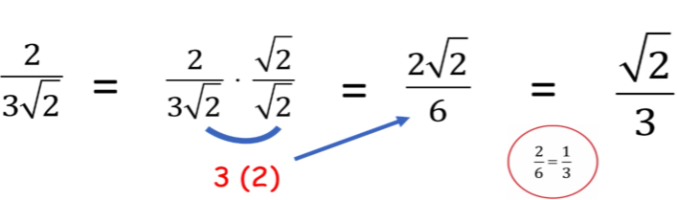
Why are we able to reduce the 2/6 while ignoring the radical expression next to it?

 
It becomes clearer if you write the entire equation with multiplications only. Can you do this by using [imath] \dfrac{1}{3}=3^{-1} [/imath] or is this new to you?
 
Fill in more steps: [math]\frac{2\sqrt{2}}{6}=\frac{2}{6}\frac{\sqrt{2}}{1}=\frac{1}{3}\frac{\sqrt{2}}{1}=\frac{\sqrt{2}}{3}[/math]
It's also useful to be able to see [imath]\frac{a\sqrt{2}}{b}[/imath] as [imath]\frac{a}{b}\sqrt{2}[/imath]: the "top floor" of a fraction is "on the same level as the ground outside". with the bottom being the "basement". So that's an alternative way to see this: [math]\frac{2\sqrt{2}}{6}=\frac{2}{6}\sqrt{2}=\frac{1}{3}\sqrt{2}=\frac{\sqrt{2}}{3}[/math]
 
It becomes clearer if you write the entire equation with multiplications only. Can you do this by using [imath] \dfrac{1}{3}=3^{-1} [/imath] or is this new to you?
If going through this 52 years ago as a High School Sophomore makes it new, then yes I'm new to it. :D
 
Fill in more steps: [math]\frac{2\sqrt{2}}{6}=\frac{2}{6}\frac{\sqrt{2}}{1}=\frac{1}{3}\frac{\sqrt{2}}{1}=\frac{\sqrt{2}}{3}[/math]
It's also useful to be able to see [imath]\frac{a\sqrt{2}}{b}[/imath] as [imath]\frac{a}{b}\sqrt{2}[/imath]: the "top floor" of a fraction is "on the same level as the ground outside". with the bottom being the "basement". So that's an alternative way to see this: [math]\frac{2\sqrt{2}}{6}=\frac{2}{6}\sqrt{2}=\frac{1}{3}\sqrt{2}=\frac{\sqrt{2}}{3}[/math]
Yes, that makes a conceptual difference!
 
If going through this 52 years ago as a High School Sophomore makes it new, then yes I'm new to it. :D

Division is, at its core, a multiplication, the multiplication by an inverse element. Inverse elements are noted by [imath] a^{-1}, [/imath] so [imath] 1/2=2^{-1} [/imath] or [imath] 1/3=3^{-1}. [/imath] This translates the equation to
[math] \dfrac{2}{3\sqrt{2}} =2\cdot \left(3\cdot \sqrt{2}\right)^{-1}=2\cdot \left(3^{-1}\cdot \sqrt{2}^{-1}\right)[/math]and we can use the facts that multiplication is commutative, [imath] a\cdot b=b\cdot a, [/imath] and associative, [imath] a\cdot (b\cdot c)=(a\cdot b)\cdot c, [/imath] and we can group the numbers and forget the order
[math] \dfrac{2}{3\sqrt{2}}= 2\cdot \sqrt{2}^{-1}\cdot 3^{-1}=\dfrac{2\sqrt{2}^{-1}}{3}. [/math]
Division is mathematically a multiplication, and this is a quasi division-free notation.

What's left to do is calculating
[math] 2\sqrt{2}^{-1}=\left(\sqrt{2}\cdot \sqrt{2}\right)\cdot \sqrt{2}^{-1}=\sqrt{2}\cdot \left(\sqrt{2}\cdot \sqrt{2}^{-1}\right)=\sqrt{2}\cdot 1=\sqrt{2}. [/math]
This path may look a bit artificial, but it results from only using the basic properties of multiplication:
  1. There is a [imath] 1, [/imath] i.e. [imath] 1\cdot a=a. [/imath]
  2. There is an inverse [imath] a^{-1}, [/imath] i.e. [imath] a\cdot a^{-1}=1. [/imath]
  3. Multiplication is associative, i.e. [imath] a\cdot (b\cdot c)=(a\cdot b)\cdot c. [/imath]
  4. Multiplication is commutative, i.e. [imath] a\cdot b=b\cdot a. [/imath]
These are mathematically the foundations of multiplication. Note that there is no division, only a multiplication by inverse elements. It has the advantage that we do not have to care about order and placement. It is also the key to those FB posts that write [imath] 2\div 3\cdot \sqrt{2} [/imath] and use the ambiguity caused by missing parentheses to initiate meaningless discussions: does it mean [imath] 2\div 3\cdot \sqrt{2}=2\cdot 3^{-1}\cdot \sqrt{2} [/imath] or [imath] 2\div 3\cdot \sqrt{2}=2\cdot 3^{-1}\cdot \sqrt{2}^{-1} \,[/imath]? Once you accept that division is only a lazy way to write multiplications by inverse elements, the ambiguity and senselessness of such posts become obvious.


Addition has the same properties with [imath] 0 [/imath] instead of [imath] 1 [/imath] as its neutral element. Subtraction is simply the addition with an inverse element, which we write as [imath] -a [/imath] to distinguish it from the multiplicative inverse. However, subtraction is a hidden addition:
[math] a-b=a+(-b) .[/math]
The only rule that combines multiplication and addition is the distributive law:
[math] a\cdot (b+c)=a\cdot b+a\cdot c. [/math]
It also explains why division by [imath] 0 [/imath] is not allowed. The neutral element of addition is simply outside the multiplicative group of the integers (or reals). The question simply doesn't arise, same as [imath] \sqrt{-1} [/imath] is irrelevant. The equation [imath] x^2+1=0 [/imath] has no solution in real numbers, so why bother about imaginary numbers?
 
Last edited:
It is also the key to those FB posts that write [imath] 2\div 3\cdot \sqrt{2} [/imath] and use the ambiguity caused by missing parentheses to initiate meaningless discussions: does it mean [imath] 2\div 3\cdot \sqrt{2}=2\cdot 3^{-1}\cdot \sqrt{2} [/imath] or [imath] 2\div 3\cdot \sqrt{2}=2\cdot 3^{-1}\cdot \sqrt{2}^{-1} \,[/imath]? Once you accept that division is only a lazy way to write multiplications by inverse elements, the ambiguity and senselessness of such posts become obvious.

That expression is not ambiguous, and it does not require grouping symbols.
This is ordinary arithmetic with the Order of Operations, PE(MD)(AS). The
products or divisions, as need be, are done from left to right in the order that
they are encountered.

[imath]a \div b * c[/imath]
or
[imath]a \div b \times c[/imath]
or
[imath]a \div b \cdot c[/imath]

The middle version is the form with which I grew up. Here is an example:

[imath]6 \div 2 \times 3 =[/imath]

[imath]3 \times 3 =[/imath]

[imath]9[/imath]

-----------------------------------------

To be taken where the product of 2 and 3 is divided into 6, grouping
symbols are needed:

[imath]6 \div (2 \times 3) =[/imath]

[imath]6 \div 6 =[/imath]

[imath]1[/imath]

----------------------------------------

Your example in the quote box can only be interpreted to mean
the former choice of which you asked.
 
That expression is not ambiguous, and it does not require grouping symbols.
It is ambiguous, and I will not start a meaningless discussion here instead of FB. There is no way to decide whether
[math] 2\div 3 \cdot \sqrt{2}=2\div \left(3\cdot \sqrt{2}\right) \quad \text{ or }\quad 2\div 3\cdot \sqrt{2}=\left(2\div 3\right)\cdot \sqrt{2}[/math] without the parentheses.

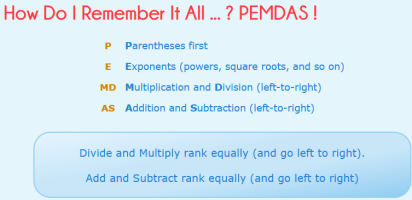
This is ordinary arithmetic with the Order of Operations, PE(MD)(AS).
This is a) unnecessary if multiplication and addition were defined correctly, b) is a rule that hides the importance of parentheses in a linear notation, and c) doesn't include the left-to-right rule you might assume.


You missed the point.

Subtraction and division are neither distributive, commutative, nor associative. That's the ambiguity in a linear notation and in particular with the (un-mathematically) sign [imath] \div [/imath] and missing parentheses.

Reducing division to multiplication and subtraction to addition resolves that problem, since both are distributive, commutative, and associative. No need for syntax (parentheses) or additional semantics (PEDMAS) rules.
 
Last edited:
It is ambiguous, and I will not start a meaningless discussion here instead of FB. There is no way to decide whether
[math] 2\div 3 \cdot \sqrt{2}=2\div \left(3\cdot \sqrt{2}\right) \quad \text{ or }\quad 2\div 3\cdot \sqrt{2}=\left(2\div 3\right)\cdot \sqrt{2}[/math] without the parentheses.
There is a way to decide, namely to follow the left-to-right rule, which is generally taught as part of the convention that is (inadequately) summarized by PEMDAS. For example,


1781532864250.png

This also makes it unambiguous to write [imath]1-2+3[/imath], which otherwise could mean either [imath](1-2)+3=2[/imath] or [imath]1-(2+3)=-4[/imath]. The standard interpretation is the former.

(Actually, some people have instead taught that multiplication is always done before division; but I think that is rare today. But even if you allow for that, there is a way to decide -- it's just that not everyone follows it!)

The unfortunate arguments happen when multiplication is not written explicitly, as in [math] 2\div 3 \sqrt{2}[/math]
Here, many people are taught that [imath]3 \sqrt{2}[/imath] is to be evaluated first, while others stick with the left-to-right rule and do the division first. (I'm not sure whether anyone explicitly teaches that.)

That is what I will not start an argument about. My preference is just not to write such an expression, knowing that it is genuinely ambiguous.
 
It is ambiguous, and I will not start a meaningless discussion here instead of FB. There is no way to decide whether
[math] 2\div 3 \cdot \sqrt{2}=2\div \left(3\cdot \sqrt{2}\right) \quad \text{ or }\quad 2\div 3\cdot \sqrt{2}=\left(2\div 3\right)\cdot \sqrt{2}[/math] without the parentheses.


This is a) unnecessary if multiplication and addition were defined correctly, b) is a rule that hides the importance of parentheses in a linear notation, and c) doesn't include the left-to-right rule you might assume.

No, I corrected you as you were giving misinformation/disinformation. It *is*
a meaningful discussion. There certainly is a way to decide, as I already explained.
There is no need to ignore the facts I laid out. You can go to the many online
calculators online and enter my first example and see how they consistently
calculate with the Order of Operations from left to right. Your example is no
different from mine, apart from the constants.

[imath]2 \div 3 \cdot \sqrt{2}[/imath] \(\displaystyle \ \ \) is another form of

[imath]2 \div 3 \times \sqrt{2}.[/imath]

Both of these abide by the Order of Operations, left to right, unambiguously.

Notice the difference how you never wrote [imath] \ 2 \div 3\sqrt{2},[/imath] (without the multiplication dot),
which is a different form and matter that Dr.Peterson posted about.
 
Last edited:
Yes, but as I already emphasized, these are linguistic rules, syntax, and semantics. Mathematics shouldn't rely on linguistic regulations, in my opinion. It is a fact that division and subtraction have none of the common mathematical properties (ass., comm., distr.) They should be regarded as what they are: abbreviations in notation. It requires notational rules to make them unique. Invisible and unspoken rules, I may add. Resolve the abbreviation, and ambiguity vanishes. I assume you won't find a serious definition of a group that mentions division or subtraction. E.g., I have been taught that dividing quotients means multiplication by the reciprocal, or that two minuses are a plus. However, I haven't seen any argument why we shouldn't start with that definition and stick by it, considering that [imath] n=\dfrac{n}{1}. [/imath] And particularly [imath] \div [/imath] is a sign I've never seen in a textbook.

You may argue that any mathematical notation is inevitably a linguistic rule, simply because of its notational character. This is true. But any understanding of mathematics starts with the resolution of notations. E.g., [imath] R_P [/imath] needs the explantion [imath] R_P=(R/P)^{-1}R [/imath] before you start dealing with [imath] R_P. [/imath] Why don't we accept this procedure when it comes to division and subtraction? They are only abbreviating notations and are mathematically unnecessary.
 
Top