
2 different SD for the same question. R

Sonal7

Full Member
Joined
Oct 4, 2019
Messages
485
Re Q5:
I am wondering where they got the SD from. Initially I thought it was a mistake as my calculation was different. They when i put it in a calculator the calculator gave me 2SDs. One answer is the one i got and the other is the one they got. But looking at the methods, its identical to mine, so someone used a calculator. Its is just a case of using n-1 which gives a slightly different answer . I just wanted to check.
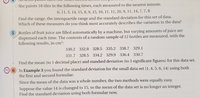

20200718_101733.jpg
I got a different answer to below which the calculator agrees which but my method was identical to theirs. My answer is 3.32
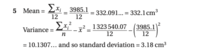
Screenshot 2020-07-18 at 14.12.34.png
 
They specify that this is a sample, so you need to use the formula for sample standard deviation, not for population standard deviation. As you imply, they use the formula for population s.d., using n=12, instead of the sample s.d., which is 3.32. I verified this in Excel, using both the built-in functions and the formulas.

So your answer is correct. The reason for the two formulas is that, for subtle reasons, the sample variance, using n-1, is a more accurate (unbiased) estimate of the population variance.
 
They shouldnt have done that given their method suggests they were not doing that. But the calculator is giving two, so i must chose the right SD as are not expected to use n-1 for A level. To confuse things an online tutorial on how to use a calculator also said to use the lower value even though that is not the right ans. I think I might need to check with a teacher with regards the syllabus. Two wrong do not make a right.
 
Yes, ask the teacher. A syllabus should not teach you to use a formula that you will later learn is inappropriate!

What exactly did that tutorial actually say? Was it for this exact problem?
 
Here is the link. I will add a comment to tell the YouTuber to correct his mistake. However if we are using n and not n-1 the answer should be smaller right? you are diving by a bigger number, so maybe we both are wrong. I cant figure out how the smaller answer if wrong and our answer is correct. I think i worked out why, its to do with subracting a relatively bigger mean and then taking the square root. That makes sense. When you use n, you actually get a bigger answer.
 
Last edited:
"At A level we just use that top one"

As far as I can tell, this is not a fault of the video, but of the people who define A-level! If they are going to ask questions about samples, then they should teach you the difference between [MATH]\sigma_x[/MATH] and [MATH]s_x[/MATH]! If they don't do the latter, they shouldn't do the former. In fact, the problem he is doing lies, because the formula they show is for [MATH]\sigma_x[/MATH], not for [MATH]s_x[/MATH] as they claim.

But apparently, if you do know the difference, you just have to lie on exams ...
 
"At A level we just use that top one"

As far as I can tell, this is not a fault of the video, but of the people who define A-level! If they are going to ask questions about samples, then they should teach you the difference between [MATH]\sigma_x[/MATH] and [MATH]s_x[/MATH]! If they don't do the latter, they shouldn't do the former. In fact, the problem he is doing lies, because the formula they show is for [MATH]\sigma_x[/MATH], not for [MATH]s_x[/MATH] as they claim.

But apparently, if you do know the difference, you just have to lie on exams ...
no I dont feel he is not asking you to lie in an exam- the exam board expects you to use technology and you are encouraged to do so. I fact its very common for them to actually give you the summary statistics for instance and you have to do little calculation. Hes just chosen the wrong value. Its definitely Sx that he should have picked. Its a silly mistake. Intuitively one might think n-1 is smaller then the bigger answer is wrong. Its quite clear in syllabus textbooks that Sx is what is needed.
 
no I dont feel he is not asking you to lie in an exam- the exam board expects you to use technology and you are encouraged to do so. I fact its very common for them to actually give you the summary statistics for instance and you have to do little calculation. Hes just chosen the wrong value. Its definitely Sx that he should have picked. Its a silly mistake. Intuitively one might think n-1 is smaller then the bigger answer is wrong. Its quite clear in syllabus textbooks that Sx is what is needed.

What I mean by lie is not about using a calculator. That's fine, as long as you know what you are doing.

I'm talking about giving the wrong answer, that is, just using "that top one" because it's what they expect of you, when (if, as I said, you had actually learned that the bottom one is the right one to use) you know it is not. If you came from another school in another country that had taught you about the sample standard deviation as different from the population standard deviation, then if you gave the right answer, you would evidently be called wrong, and that bothers me.

Yes, sx is what is needed -- but the formula they've shown you is not for sx, but for σx. They've lied to you! He is saying, we have chosen not to teach you the right thing, but to tell you to use this other thing, because it's simpler.

And, no, it is not a silly mistake. He didn't pick the top one because it's smaller, and he thought it was sx, but because it is the one that matches the (wrong) formula they gave, and he knows that.

But again, none of this is criticizing students, or even teachers, but the curriculum designers.
 
What I mean by lie is not about using a calculator. That's fine, as long as you know what you are doing.

I'm talking about giving the wrong answer, that is, just using "that top one" because it's what they expect of you, when (if, as I said, you had actually learned that the bottom one is the right one to use) you know it is not. If you came from another school in another country that had taught you about the sample standard deviation as different from the population standard deviation, then if you gave the right answer, you would evidently be called wrong, and that bothers me.

Yes, sx is what is needed -- but the formula they've shown you is not for sx, but for σx. They've lied to you! He is saying, we have chosen not to teach you the right thing, but to tell you to use this other thing, because it's simpler.

And, no, it is not a silly mistake. He didn't pick the top one because it's smaller, and he thought it was sx, but because it is the one that matches the (wrong) formula they gave, and he knows that.

But again, none of this is criticizing students, or even teachers, but the curriculum designers.
Oh the other one (not Sx) matches the correct ans. I think they are keeping it simple for us. They think our brains will pop if they teach us all of it correctly. Anyway seems like the Sx is the one to pick and hes gone for the wrong one- I say wrong as he has used n and not n-1, even though the correct ans the top one if its is population we are dealing with. All textbooks touch upon the population SD and say that forget for now, that and use n (instead of n-1). I will use Sx as that matches my calculations where i used n.
 
Last edited:
Oh the other one (not Sx) matches the correct ans. I think they are keeping it simple for us. They think our brains will pop if they teach us all of it correctly. Anyway seems like the Sx is the one to pick and hes gone for the wrong one- I say wrong as he has used n and not n-1, even though the correct ans the top one if its is population we are dealing with. All textbooks touch upon the population SD and say that forget for now, that and use n (instead of n-1). I will use Sx as that matches my calculations where i used n.
Exactly. (Of course, you mean "all textbooks" for your course, not those at a higher level or in places with different curricula.)

Therefore, if you happen across a site that uses the n-1 version, just ignore it for now.
 
Top