Another probability problem

Sharnice

New member
Joined
Nov 24, 2019
Messages
24
Hi all,
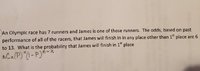
I have another probability problem that I've been trying to figure out for much too long and I'm just stuck. I've included a formula on the attachment that MAY be the one that I'm supposed to use but I'm not sure because there are so many diff formulas. Please help! Thanks!
 

Attachments

  • stat1.jpg
    stat1.jpg
    35 KB · Views: 5
Please follow posting guidelines: show your work, etc.
Yes, there are many formulas, but your textbook should describe when each one should be used and provide examples.
Hint: if probability of an event occurring is X, what is the probability of it not occurring?
 
Hi, Sharnice.

I can sort of see why you might think this could be a binomial distribution problem, since there is a mention of a number of runners. What I recommend, though, is not to try to decide what method to use too early in the process. I'd start by collecting the data, something like this:
  • James is one of 7 runners.
  • Odds that James will not finish in first are 6:13.
  • Goal: probability that James will finish in first place.
The first thing I see is that we are given odds, and want a probability; so converting the odds to a probability will be part of our work. I might do that immediately.

Another thing I see is that the number of runners is relevant only in terms of how many possible places there are; it is not a number of trials, so this is not about the binomial distribution.

Then (partly because I paraphrased the data), I see that we are given a "not" and asked for the opposite. That's important.

So, let's have you take the first step: what is the probability of not finishing in first place?
 
Hi, Sharnice.

I can sort of see why you might think this could be a binomial distribution problem, since there is a mention of a number of runners. What I recommend, though, is not to try to decide what method to use too early in the process. I'd start by collecting the data, something like this:
  • James is one of 7 runners.
  • Odds that James will not finish in first are 6:13.
  • Goal: probability that James will finish in first place.
The first thing I see is that we are given odds, and want a probability; so converting the odds to a probability will be part of our work. I might do that immediately.

Another thing I see is that the number of runners is relevant only in terms of how many possible places there are; it is not a number of trials, so this is not about the binomial distribution.

Then (partly because I paraphrased the data), I see that we are given a "not" and asked for the opposite. That's important.

So, let's have you take the first step: what is the probability of not finishing in first place?

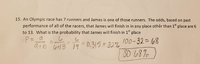
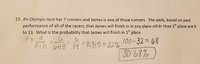
This is what I came up with
 

Attachments

  • stat3jpg.jpg
    stat3jpg.jpg
    259.1 KB · Views: 3
That is correct. I would give the answer as a fraction, however, rather than a rounded percentage:

[MATH]1-\frac{6}{19} = \frac{13}{19} \approx 0.6842 = 68.42\%[/MATH]​

If the nearest percent is standard in your class, then your answer should be accepted. Good work.
 
That is correct. I would give the answer as a fraction, however, rather than a rounded percentage:

[MATH]1-\frac{6}{19} = \frac{13}{19} \approx 0.6842 = 68.42\%[/MATH]​

If the nearest percent is standard in your class, then your answer should be accepted. Good work.
Thank you!
 
Top