
Answering questions from a Venn diagram.

saneye93

New member
Joined
Jul 20, 2020
Messages
5
This is my first time seeing a Venn diagram like this one. I tried to answer the questions. Are my answers correct?

In the Venn diagram, the number of elements are as shown. (in the picture)
Given that E=P union Q union R and n(E) = 35. (E is the universal set)
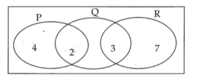
Screenshot 2020-07-21 at 9.37.35 AM.png

Find:
(a) n(P union R) = 4+2+3+7=16
(b) n(P intersect R) = 2+3=5
(c) n(P' intersect R') = 35-16 = 19
 
This is my first time seeing a Venn diagram like this one. I tried to answer the questions. Are my answers correct?

In the Venn diagram, the number of elements are as shown. (in the picture)
Given that E=P union Q union R and n(E) = 35. (E is the universal set)
View attachment 20578

Find:
(a) n(P union R) = 4+2+3+7=16
(b) n(P intersect R) = 2+3=5
(c) n(P' intersect R') = 35-16 = 19
Does the diagram have any number that in in both \(P\cap R~?\)
 
Technically, this is an Euler diagram, not a Venn diagram, though the terms are often confused (even by me).

I presume you've seen that two regions have no numbers in them, so the first task is to fill them in. Did you do that?

Then consider pka's question.
 
P only contains the regions that has 2 and 4 while R only contains the regions that contain 3 and 7. P and R have no elements in common. Do you not see that. Please explain why so we can clear up your thinking.
Also, it is not true that everything in P is in Q, same with R and Q.
 
I don't see anywhere, in what you say, that "n(A)", for set A, is defined. Was that done separately? From what you have done, it appears to be the sum of the numbers in the set. But then, where does "\(\displaystyle n(E)= 35\) come from? The sum of all numbers shown is 16, not 35.
 
I don't see anywhere, in what you say, that "n(A)", for set A, is defined. Was that done separately? From what you have done, it appears to be the sum of the numbers in the set. But then, where does "\(\displaystyle n(E)= 35\) come from? The sum of all numbers shown is 16, not 35.
n(A) means the cardinality of A (the number of elements). That is common at an introductory level. And the numbers in the diagram are the number of elements in each region (which is stated explicitly). Two regions are blank, which I presume are to be filled in.

All this is probably known from context in the book (or whatever the source is); but the last presumed fact (at least) really should be stated, rather than being implied by the fact that the numbers don't add up to 35.
 
Top