arc in circle

shahar

Full Member
Joined
Jul 19, 2018
Messages
554
The question is:
1774361323812.png

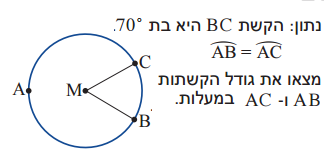
Given: Arc BC size is 70 degree.
Arc AB = Arc AC.
Find the size of the arcs AB and AC.
The source:
נתון: הקשת BC היא בת 70 מעלות.
AB = AC
מצאו את גודל AB ו-AC במעלות.
How to solve it in Geometric Proof solution.
I know to caculate it as (360-70) /2 to each arc.
How I can formulate it as Geometric Proof.
 
The question is:
View attachment 39986

Given: Arc BC size is 70 degree.
Arc AB = Arc AC.
Find the size of the arcs AB and AC.
The source:
נתון: הקשת BC היא בת 70 מעלות.
AB = AC
מצאו את גודל AB ו-AC במעלות.
How to solve it in Geometric Proof solution.
I know to caculate it as (360-70) /2 to each arc.
How I can formulate it as Geometric Proof.
I don't understand the Hebraic content of your post but, unless it is saying something you haven't translated, I'm at a loss to know what you mean by a "Geometric Proof".

Given that
\(\displaystyle \overset{\frown}{BC}=70°\text{ and }\overset{\frown}{AB}=\overset{\frown}{AC}\) your "calculation" \(\displaystyle \left(\overset{\frown}{AB}=\overset{\frown}{AC}=\frac{360°-70°}{2}=145°\right)\) is absolutely correct.

Why would you need anything more? 🤷‍♂️
 
How do you describe [imath] \measuredangle (BMC) = 70° [/imath] geometrically? [imath] \overset{\frown}{AB}=\overset{\frown}{AC}[/imath] is a definition. It establishes a symmetry that you can use. But in order to "compute" something geometrically, you need a geometric input.
 
How do you describe [imath] \measuredangle (BMC) = 70° [/imath] geometrically? [imath] \overset{\frown}{AB}=\overset{\frown}{AC}[/imath] is a definition. It establishes a symmetry that you can use. But in order to "compute" something geometrically, you need a geometric input.
I understand that less than the Hebraic. 🤣
 
I understand that less than the Hebraic. 🤣

נניח שהזווית היא 60°. אז אפשר לשאול מדוע אחת הזוויות גדולה פי שניים וחצי מכך. אבל איך אפשר בכלל לתאר גיאומטרית את 145°, הפתרון? :D
(Google Translate is fun!)

Let's say the angle is 60°. So we could ask why one of the angles is two and a half times larger. But how can we even geometrically describe 145°, the solution?
 
I don't understand the Hebraic content of your post but, unless it is saying something you haven't translated, I'm at a loss to know what you mean by a "Geometric Proof".

Given that
\(\displaystyle \overset{\frown}{BC}=70°\text{ and }\overset{\frown}{AB}=\overset{\frown}{AC}\) your "calculation" \(\displaystyle \left(\overset{\frown}{AB}=\overset{\frown}{AC}=\frac{360°-70°}{2}=145°\right)\) is absolutely correct.

Why would you need anything more? 🤷‍♂️
No. I understand the geometric proof changes from place to place. I know in Israel, we can answer the question wiith table of argument and reason (to the argument). Isn't it in English Mathematics? (?!)
 
No. I understand the geometric proof changes from place to place. I know in Israel, we can answer the question wiith table of argument and reason (to the argument). Isn't it in English Mathematics? (?!)
This video may help you...


From "Google" (qv) there is the following advice:-

A geometry proof is a logical, step-by-step argument that establishes the truth of a geometric statement using definitions, postulates, and theorems. It typically starts with given information, moves through logical deductions, and concludes with the assertion to be proven, often organized as a two-column, paragraph, or flow chart proof.

and these guidelines/tips...


Key Elements of Geometry Proofs:
  • Diagrams: Always draw and mark the figure with given information, such as congruent sides or angles.
  • Given and Goal: Clearly list what is known (hypotheses) and what needs to be proven.
  • Logical Steps: Each step must follow from the previous one, with a valid reason (e.g., midpoint definition, Angle Addition Postulate).
  • Definitions & Theorems: Reasons are justified by accepted geometric theorems, postulates, and definitions.
  • Two-Column Format: The most common structure, featuring numbered statements on the left and corresponding reasons on the right.
Common Reasons Used in Proofs:
  • Vertical Angles Theorem: Vertically opposite angles are equal.
  • Triangle Sum Theorem: Angles in a triangle sum to

    .
  • Congruent Triangles: SAS, SSS, ASA, AAS, and HL.
  • Algebraic Properties: Transitive, substitution, and addition properties.
  • Definitions: Midpoint (creates congruent segments), perpendicular (creates angles)


    Tips for Success:
  • Do not skip steps: Write down every logical step in the derivation.
  • Mark figures: Mark new deductions on your diagram to see the connections.
  • Work backward: If stuck, start from the conclusion and figure out what you need to know to reach it.

This other video offers an alternative approach to laying out a proof....


Hope that helps. 😊
 
You may also find these videos on Circle Theorems and their proofs useful in your efforts...
(NB: I suggest you click the (black) "Watch on YouTube" button at the bottom left rather than the (red) "Play" buttons in the middle; the latter plays the video in here while the former opens a new tab where you can watch fullscreen. 👍)


&


Hope that helps. 😊
 
Top