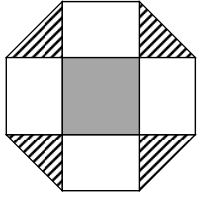
areas in regular octagon

shahar

Full Member
Joined
Jul 19, 2018
Messages
548
How Can I prove that the areas equal? (the striped trinagles' area [(1}] and - the area [(2)] of the square area)
It came from a Question of the Israeli SAT test.
(I can't log in to another site or use AI because the computer of me now is very old)
1772481609260.png
 
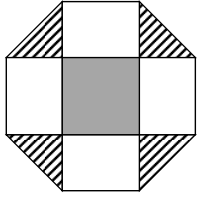
How Can I prove that the areas equal? (the striped trinagles' area [(1}] and - the area [(2)] of the square area)
It came from a Question of the Israeli SAT test.
(I can't log in to another site or use AI because the computer of me now is very old)
View attachment 39969
Where is "the area [(2)] of the square area) "? What other information are given?
 
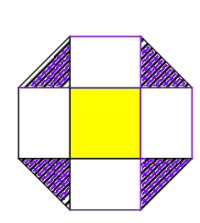
Why does the purple area equals to yellow area?
1772483945700.png
I see it but I don't understand how to prove it?
 
Why does the purple area equals to yellow area?
1772489733814.png
I see it but I don't understand how to prove it?
Assuming that the overall shape forms a regular octagon, meaning all outer edges are equal in length, then the central square has side length the same as the octagon's sides; let us call that "s".

The hypotenuse of each triangle is also "s" so the legs of the triangles (let's call them "l" as they are all the same length too) are related to the sides of the octagon via Pythagoras' Theorem, ie:-


\(\displaystyle s^2=l^2+l^2=2l^2\)

Having established that \(\displaystyle s^2=2l^2\), you can now calculate the areas of the central square (whose side is s) and that of the four triangles (for each, use A=½×base×height and treat one leg (l) as the base and the other leg as the height).

Finally, comparing the expressions you get for these areas you should be able to confirm that they are equal.

If you can't finish from there I can only complete the problem for you (further "help" is difficult to provide) so please try to finish it yourself.

However, if you're still really stuck, the answer can be provided.

Hope that helps. 😊
 
Top