I'm working on 3d modeling horn subwoofers and have run into a problem that I can't figure out how to solve by myself. I've been learning calculus from khan academy videos in an attempt to solve this, but I feel that it is still out of my reach.
Here is an image to help explain the problem:

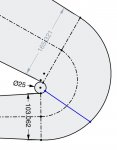
There is a triangle (horn) with an arbitrary slope and length. I want to be able to bend the triangle at any point along it's length, to any angle 0 to 180 deg. The length is measured with a line down the center of the triangle. The bend has a arbitrary constant inside radius.
Here is the problem:
The bend needs to have the same slope as the triangle, Width/Length.
Width is measured from the inside radius to the outside at any angle theta with the polar center being the center of the inside radius.
The Length is the arc length of the curve from Width/2 at theta = 0, to Width/2 at any point along the line. any point on the arc is the middle point at that angle.
To figure out the arc length from 0 to point A I need to know the Width at point A, To know the Width at point A I need the arc length from 0 to point A.
Here is an image to help explain the problem:
There is a triangle (horn) with an arbitrary slope and length. I want to be able to bend the triangle at any point along it's length, to any angle 0 to 180 deg. The length is measured with a line down the center of the triangle. The bend has a arbitrary constant inside radius.
Here is the problem:
The bend needs to have the same slope as the triangle, Width/Length.
Width is measured from the inside radius to the outside at any angle theta with the polar center being the center of the inside radius.
The Length is the arc length of the curve from Width/2 at theta = 0, to Width/2 at any point along the line. any point on the arc is the middle point at that angle.
To figure out the arc length from 0 to point A I need to know the Width at point A, To know the Width at point A I need the arc length from 0 to point A.