
Calc 1: find a, b, so lim[x->0] (sin(2x)/x^3 + a + b/x^2) = 0 is true

Mays

New member
Joined
May 8, 2016
Messages
2
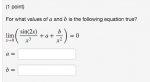
For what values of a and b is the following equation true:

. . .\(\displaystyle \displaystyle \lim_{x\, \rightarrow\, 0}\, \left(\, \dfrac{\sin(2x)}{x^3}\, +\, a\, +\, \dfrac{b}{x^2}\, \right)\, =\, 0\)


Any help would be appreciated!!!

For what values a and b is the following equation true?

lim as x -> 0 of {(sin(2x)/x^3) + a + (b/x^2)} = 0

Sent from my iPhone using Tapatalk
 

Attachments
  • Image1462683504.677021.jpg
    Image1462683504.677021.jpg
    18.1 KB · Views: 2
Last edited by a moderator:
For what values of a and b is the following equation true:

. . .\(\displaystyle \displaystyle \lim_{x\, \rightarrow\, 0}\, \left(\, \dfrac{\sin(2x)}{x^3}\, +\, a\, +\, \dfrac{b}{x^2}\, \right)\, =\, 0\)

What are your thoughts?

Please share your work with us ...even if you know it is wrong

If you are stuck at the beginning tell us and we'll start with the definitions.

You need to read the rules of this forum. Please read the post titled "Read before Posting" at the following URL:

http://www.freemathhelp.com/forum/th...Before-Posting
 
Last edited by a moderator:
What are your thoughts?

Please share your work with us ...even if you know it is wrong

If you are stuck at the beginning tell us and we'll start with the definitions.

You need to read the rules of this forum. Please read the post titled "Read before Posting" at the following URL:

http://www.freemathhelp.com/forum/th...Before-Posting

I literally don't even know where to start. We just learned L'Hôpital's rule though so I thought maybe we're supposed to use that? I just don't know what even to do. I took the derivative (for l'hopitals) of the first part and figured if a and b are constants then after taking the derivative, those are just 0 and irrelevant but it left me with limit as x-> 0 of 8cos(2x)/6 which I think is 4/3... And obviously thats not zero and since a and b aren't even part of it anymore I don't have any idea what to do.
 
It seems this post got lost in the shuffle, sorry about that. You might not need help any longer, but here goes:

You say you've learned L'Hopital's rule. So you know you can only apply that rule to limits of fractions that have indeterminate forms (\(\displaystyle \displaystyle \frac{0}{0}, \: \frac{\infty}{\infty}, \: or \: \frac{-\infty}{-\infty}\)). I'd begin by applying the limit sum rule to break the limit apart into three pieces.

\(\displaystyle \displaystyle \lim _{x\to 0}\left(\frac{sin\left(2x\right)}{x^3}+a+\frac{b}{x^2}\right)=\lim _{x\to 0}\left(\frac{sin\left(2x\right)}{x^3}\right)+\lim _{x\to 0}\left(a\right)+\lim _{x\to 0}\left(\frac{b}{x^2}\right)\)

Of these three parts, which can you apply L'Hopital's Rule to? What do you get when you apply it to those parts? What about the other parts? To what do they evaluate? After applying L'Hopital's Rule, when you add all three parts together, what do you get? What does this tell you about the potential answers to this problem?
 
Top