Can anyone help me?Need to use Bayes' Theorem.

Are you required to use Bayes' theorem explicitly?

This is essentially the same thing (using the ideas behind Bayes theorem):
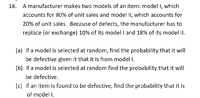
Imagine the manufacturer makes 10000 items. 80%, 8000, are model I and 20%, 2000, are model II. Of the 8000 model I, 10%, 800, are defective and 7200 are not. Of the 2000 model II, 18%, 360, are defective and 1640 are not.

(a) If a model is selected at random find the probability that it will be defective given that it is from model I.
This is easy- since we were told that 10% of model I are defective, this probability is 10% or 0.10.

(b) If a model is selected at random find the probability that it will be defective.

Of all 10000 items, how many were defective? What fraction is that?

(c) If an item is defective find the probability it is of model I.
Of the total that were defective, how many were model I? What fraction is that?

 
Yeah we have to use Bayes' Theorem except for b).What makes me confuse is the last line?Assume A and B are Machine 1 and Machine 2 respectively. Is it A given defective or the other way round?
Sorry i did not mention my problem.i thought i did.
Thanks for the reply tho.
 
Here are the setups:
a) \(\displaystyle \mathcal{P}(D|I)=\dfrac{\mathcal{P}(D\cap I)}{\mathcal{P}(I)}\)
b) \(\displaystyle \mathcal{P}(D)=\mathcal{P}(D\cap I)+\mathcal{P}(D\cap I I)\)
c) \(\displaystyle \mathcal{P}(I|D)\)
 
Here are the setups:
a) \(\displaystyle \mathcal{P}(D|I)=\dfrac{\mathcal{P}(D\cap I)}{\mathcal{P}(I)}\)
b) \(\displaystyle \mathcal{P}(D)=\mathcal{P}(D\cap I)+\mathcal{P}(D\cap I I)\)
c) \(\displaystyle \mathcal{P}(I|D)\)
I figured out all 3 question but i can't figure out about the statement of the last line.
Thanks for the reply.
 
I figured out all 3 question but i can't figure out about the statement of the last line.
How can that be true? You say that you figured out all three but do not understand the last line.
That is self-contradictory. Please explain!
 
Top