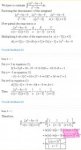
K kluda06 New member Joined Apr 28, 2013 Messages 12 Oct 7, 2013 #1 I high lighted what I am confused about. Can someone explain to me how it becomes (x+3)^2 as well as how ln x combines with ln (x+3)^2 < link to objectionable page removed > Last edited by a moderator: Sep 2, 2017
I high lighted what I am confused about. Can someone explain to me how it becomes (x+3)^2 as well as how ln x combines with ln (x+3)^2 < link to objectionable page removed >
stapel Super Moderator Staff member Joined Feb 4, 2004 Messages 16,550 Oct 7, 2013 #2 The text in the image is too small for me to read. Could you type things out, or post larger images? Thank you!
The text in the image is too small for me to read. Could you type things out, or post larger images? Thank you!
D Deleted member 4993 Guest Oct 7, 2013 #3 kluda06 said: View attachment 3281 I high lighted what I am confused about. Can someone explain to me how it becomes (x+3)^2 as well as how ln x combines with ln (x+3)^2 <link removed> Click to expand... Those come from the following rules of logarithms: b * ln(a) = ln(ab) and ln(p) + ln(q) = ln(p*q) and ln(m) - ln(n) =\(\displaystyle \displaystyle ln\left (\frac{m}{n}\right )\) Last edited by a moderator: Sep 2, 2017
kluda06 said: View attachment 3281 I high lighted what I am confused about. Can someone explain to me how it becomes (x+3)^2 as well as how ln x combines with ln (x+3)^2 <link removed> Click to expand... Those come from the following rules of logarithms: b * ln(a) = ln(ab) and ln(p) + ln(q) = ln(p*q) and ln(m) - ln(n) =\(\displaystyle \displaystyle ln\left (\frac{m}{n}\right )\)