
You are using an out of date browser. It may not display this or other websites correctly.
You should upgrade or use an alternative browser.
You should upgrade or use an alternative browser.
Checking for radical equation
- Thread starter askan
- Start date


Dr.Peterson
Elite Member
- Joined
- Nov 12, 2017
- Messages
- 16,890
Couldn't the square root of 4 have equaled to -2? That would have made x = 2 a solution for the equation
View attachment 39924
What is the problem you are solving? And where did you get this work that you evidently disagree with? Coming into a discussion after the beginning can be tricky!
It looks like this is the final step in solving [imath]\sqrt{x^2-2x+4}+4=x[/imath], though I can't be certain.
The answer to your question is that when we write [imath]\sqrt{x}[/imath], by definition that refers to the principal square root, which is the non-negative one. If we want to refer to both roots, we explicitly write [imath]\pm\sqrt{x}[/imath].
See here:

Square root - Wikipedia
Why? Because we want a symbol to mean only one thing at a time; expressions that have two possible meanings are very awkward to work with. (There are some fields in which we need to do that, but we try not to when it is not necessary.) So we want the radical symbol to represent a function, not an ambiguous relation.
Your observation is, in fact, how we can know that this is an extraneous solution, not just a mistake: The traditional method of solving such an equation actually solves two equations at once, one with each of the possible signs for the radical, since squaring loses information about that sign. So when you discover that your solution works in the "other" equation, that supports the correctness of your work, even while it shows that you must ignore this solution.
So [imath]x=2[/imath] is actually a solution of [imath]-\sqrt{x^2-2x+4}+4=x[/imath].
If you study extraneous solutions of radical equations in an algebra book, you will learn this. The reason they do the check at the end is precisely this possibility of having solved "the other equation" accidentally, while doing correct work.
The problem, and it's solution is from a course I am doing on Algebra 1 & 2. Here's the problem as statedWhat is the problem you are solving? And where did you get this work that you evidently disagree with?

So I have three issues here.So we want the radical symbol to represent a function, not an ambiguous relation.
1. A function is supposed to be represented by a combination of two variables, X and Y. In this equation, there's no Y variable which we might exchange with f(x) to represent a function. So I am not sure if the primary intention here was to represent a function.
2. As I understand it, the range of a equation is determined by the nature of the equation itself. Can we by our own means limit the range without any trouble?
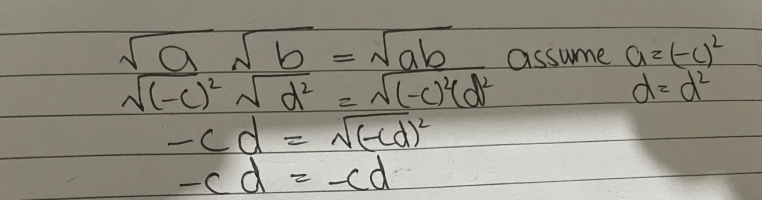
3. The question of which root to prefer, - or +. I understand you have answered this question in another thread, but by my calculations if even the - root is kept consistent on both sides, the algebraic formula [imath](\sqrt{a}\times \sqrt{b}) = \sqrt{ab}[/imath] remains.
Dr.Peterson
Elite Member
- Joined
- Nov 12, 2017
- Messages
- 16,890
I don't think you understand the concept of a function. There is no need for explicit variables x and y; we commonly use x to represent an input, and y an output. In the square root, [imath]y=\sqrt{x}[/imath], the input is x, and the output is y, the value of the radical. This has only one value, making it a function. Did you read my link to Wikipedia?1. A function is supposed to be represented by a combination of two variables, X and Y. In this equation, there's no Y variable which we might exchange with f(x) to represent a function. So I am not sure if the primary intention here was to represent a function.
I don't understand what you are saying here. (What equation do you see here? What is the range of an equation?)2. As I understand it, the range of a equation is determined by the nature of the equation itself. Can we by our own means limit the range without any trouble?
We have traditionally defined the radical to mean the non-negative root, so its range is the non-negative real numbers.
Do you not notice that, if your a, b, c, and d are all positive numbers, and you are defining the radical to always represent the negative root, then [imath]\sqrt{d^2}[/imath] can't equal [imath]d[/imath], since that's the positive root? Your work here ignores the point of the discussion, which was the sign of the output of the function (assuming we do define it as a function, but make a different choice of "preferred" root, as you expressed it).3. The question of which root to prefer, - or +. I understand you have answered this question in another thread, but by my calculations if even the - root is kept consistent on both sides, the algebraic formula [imath](\sqrt{a}\times \sqrt{b}) = \sqrt{ab}[/imath] remains.
View attachment 39929
In particular, if we define [imath]\sqrt{4}=-2[/imath] and [imath]\sqrt{9}=-3[/imath], then on one hand [imath]\sqrt{4}\sqrt{9}=(-2)(-3)=6[/imath], while on the other hand [imath]\sqrt{4\cdot9}=\sqrt{36}=-6[/imath]. So it is not true that [imath](\sqrt{a}\cdot \sqrt{b}) = \sqrt{ab}[/imath].
That's why, given that we want the symbol to represent a function (a single value for a given input), the better choice is the non-negative root.
I wasn't sure which side of the equation (the one in the ss that I posted) to render equal to f(x), to represent a function of the entire equation. Since on picking any one side, I would be leaving out the other. That's why I asked that question.I don't think you understand the concept of a function.
Let me try to explain myself as concisely as I can.What equation do you see here? What is the range of an equation?
The equation I had in mind was this, [imath]f(x) = \sqrt{x}[/imath]. I had assumed that ([imath]\sqrt{x} = x^{\frac{1}{2}}[/imath]). So to limit the range of this function to only positive roots seemed something imposed from the outside to keep the function coherent, rather then something implied by the nature of the equation itself. As shown in this,
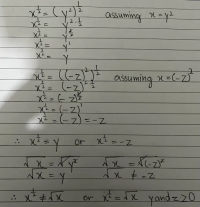
But as shown, [imath]\sqrt{x} \neq x^{\frac{1}{2}}[/imath]. So my assumption was wrong, or there was some third statement not implied by the equation itself added onto it i.e. [imath]y \ge 0 \quad \text{and} \quad z \ge 0[/imath].
I see. So that answers the how, and the why for allowing only one of the two roots. We prefer the positive root because it allows more variety of algebraic formulas.That's why, given that we want the symbol to represent a function (a single value for a given input), the better choice is the non-negative root.
Last edited:
Dr.Peterson
Elite Member
- Joined
- Nov 12, 2017
- Messages
- 16,890
Part of the trouble here is that you are using words incorrectly. I don't know what the bold phrase is intended to mean, but it is not how we use the words "function" and "equation"!I wasn't sure which side of the equation (the one in the ss that I posted) to render equal to f(x), to represent a function of the entire equation. Since on picking any one side, I would be leaving out the other. That's why I asked that question.
So to limit the range of this function to only positive roots seemed something imposed from the outside to keep the function coherent, rather then something implied by the nature of the equation itself.
I'd much rather say that we simply want to define a function that gives one of the square roots of a given number. Talk of "equations" only muddles the idea. We don't "limit" the range of an existing function; we are defining a function that turns out to have a certain range. And the "extra thing" we consider is that we want a function.So my assumption was wrong, or there was some third statement not implied by the equation itself added onto it i.e. y≥0andz≥0y \ge 0 \quad \text{and} \quad z \ge 0y≥0andz≥0.
If I am understanding you correctly, functions are only equal to mathematical expressions e.g. 4x, 2(x-1), not equations. So function of a equation is misnomer?Part of the trouble here is that you are using words incorrectly.
I had in mind something like f(x)= [imath]\sqrt{x^2 - 2x + 4} + 4 = x[/imath], if that makes sense.I don't know what the bold phrase is intended to mean
Oh you mean the function only exists once we allow for only one root.We don't "limit" the range of an existing function; we are defining a function that turns out to have a certain range.
I think perhaps my biggest misunderstanding here was the assumption that [imath]\sqrt{x} = x^{\frac{1}{2}}[/imath]. [imath]\sqrt{x}[/imath] is only a derived concept of [imath]x^{\frac{1}{2}}[/imath]. If I understood that this [imath]\sqrt{x} = x^{\frac{1}{2}}[/imath] was false, I would have picked up your point quickly. Nonetheless, I am better for it.
It does not. Do you mean the function [imath]f(x)=\sqrt{x^2-2x+4}[/imath] or the function [imath]f(x)=x[/imath] ? These are two totally different functions.I had in mind something like f(x)= [imath]\sqrt{x^2 - 2x + 4} + 4 = x[/imath], if that makes sense.
I think your confusion lies with not completely understanding what a function is. You should go back and make sure you understand this first.
Dr.Peterson
Elite Member
- Joined
- Nov 12, 2017
- Messages
- 16,890
Yes, that is a big part of what was wrong with that.If I am understanding you correctly, functions are only equal to mathematical expressions e.g. 4x, 2(x-1), not equations. So function of a equation is misnomer?
But you didn't just say that the equation is a function, but that something is a function OF an equation. We talk about one variable or value being a function OF a variable or value, not of an equation, meaning that that value is the input to the function; the function is often (but not always) an expression involving the input value.
I wondered if this is partly just an English language error. Possible when you say "function of the equation", you might mean that the square root is a function USED IN the equation[imath]\sqrt{x^2 - 2x + 4} + 4 = x[/imath]. But here, that isn't at all what you said; you can never say that f(x) is equal to an entire equation. That really makes no sense at all. It would have to mean either that f(x) is equal to both sides of the equation, or that f(x) is equal to the "value" of the equation, which is either "true" or "false", depending on the value of x. I very much doubt that you meant this.I had in mind something like f(x)= [imath]\sqrt{x^2 - 2x + 4} + 4 = x[/imath], if that makes sense.
Yes, you need to go back and read a textbook chapter about what a function is, and not only read it, but master the concept.
I don't think this is really part of your problem. The other discussion you joined started with rational powers, which gets into some subtleties that go well beyond what we are talking about here. I would say that [imath]\sqrt{x}[/imath] is defined simply as the non-negative number whose square is x; and [imath]x^{\frac{1}{2}}[/imath] is defined as [imath]\sqrt{x}[/imath], with some caveats that come into play mostly when you deal with complex numbers.I think perhaps my biggest misunderstanding here was the assumption that [imath]\sqrt{x} = x^{\frac{1}{2}}[/imath]. [imath]\sqrt{x}[/imath] is only a derived concept of [imath]x^{\frac{1}{2}}[/imath]. If I understood that this [imath]\sqrt{x} = x^{\frac{1}{2}}[/imath] was false, I would have picked up your point quickly. Nonetheless, I am better for it.
One of the difficulties in learning mathematics is that the student must learn the technical meanings of a number of words that are very carefully defined. The student must also learn the meanings of certain symbols.
In elementary algebra, an “expression” is a combination of symbols that represents a number (usually a real number in elementary algebra). Examples: 3, x + y, 3a - 2b.
In elementary algebra, an equation is a statement that two expressions represent the same number. The solution set of an equation or system of equations are the numbers that make that statement or statements true. A solution set may have multiple elements. Example, xy = 36 and x^2 = 16 has the solution set of (4, 9) and (-4, -9).
In elementary algebra, a function uniquely and thus unambiguously maps each element (the “argument”) of one set (the domain) to a number in a set of numbers. (The mapping is not necessarily reversible.) The elements of the domain may be numbers, ordered pairs of numbers, ordered triples of numbers and so on. The mapping may be expressed in the form of an equation such as z = 3x + y, but it can be expressed in others ways such as “ the non-negative number that, when squared, equals the argument of the function.” A function is defined by specifying two sets and an unambiguous rule mapping each element in the domain to a unique element in the other set.
These are distinct ideas. For example, a function has a unique answer, but equations may have multiple answers. But they are closely related ideas, and students can easily get confused.
In elementary algebra, an “expression” is a combination of symbols that represents a number (usually a real number in elementary algebra). Examples: 3, x + y, 3a - 2b.
In elementary algebra, an equation is a statement that two expressions represent the same number. The solution set of an equation or system of equations are the numbers that make that statement or statements true. A solution set may have multiple elements. Example, xy = 36 and x^2 = 16 has the solution set of (4, 9) and (-4, -9).
In elementary algebra, a function uniquely and thus unambiguously maps each element (the “argument”) of one set (the domain) to a number in a set of numbers. (The mapping is not necessarily reversible.) The elements of the domain may be numbers, ordered pairs of numbers, ordered triples of numbers and so on. The mapping may be expressed in the form of an equation such as z = 3x + y, but it can be expressed in others ways such as “ the non-negative number that, when squared, equals the argument of the function.” A function is defined by specifying two sets and an unambiguous rule mapping each element in the domain to a unique element in the other set.
These are distinct ideas. For example, a function has a unique answer, but equations may have multiple answers. But they are closely related ideas, and students can easily get confused.
When I used the phrase, "function of an equation", I meant "the equation is a function". The use was informal here, partly because I wasn't aware the phrase, "Y(Output) is a function of X(Input)" was showing a dependency relation. Indeed, no value depends on a equation, as a equation is a constraint, not a expression per se. But to keep myself clear, I will state how I am using them from now on.But you didn't just say that the equation is a function, but that something is a function OF an equation
1. "f is a function"
f is a mathematical expression (e.g. 4x, 3(x-3)) that takes one value and returns one and only one output.
2. "Y is a function of x"
Y(Output) is a value that depends on X(Input). In other words, X explains why Y is this value, not that.
Do you mean the function f(x)=x2−2x+4f(x)=\sqrt{x^2-2x+4}f(x)=x2−2x+4 or the function f(x)=xf(x)=xf(x)=x ? These are two totally different functions.
By a function, I understand a relation that takes any one value x, and relates it to one and only one value Y. Now, I understand what a function is, but the question here is of how to represent it. The point "mrtwhs" raises is a good one to show that.you can never say that f(x) is equal to an entire equation. That really makes no sense at all.
Given that we know [imath]\sqrt{x^2 - 2x + 4} + 4 = x[/imath], both functions [imath]f(x)=\sqrt{x^2-2x+4}+4[/imath] and [imath]f(x) = x[/imath] give exactly the same output y for the same input x, or rather that output y and input x are identical. Given such, even if we do say that [imath]f(x)=\sqrt{x^2-2x+4} + 4 = x[/imath], we are getting only one output Y for every input x. So it technically represents a function. Which is really not that different from what you say here:
It would have to mean either that f(x) is equal to both sides of the equation
I don't understand what this means. We already know that x^1/2 is not equal to [imath]\sqrt{x}[/imath]. So what does it mean to define them as equal?[imath]x^{\frac{1}{2}}[/imath] is defined as [imath]\sqrt{x}[/imath]
Last edited:
Dr.Peterson
Elite Member
- Joined
- Nov 12, 2017
- Messages
- 16,890
Why do you say this? How do you know it is true?I don't understand what this means. We already know that x^1/2 is not equal to [imath]\sqrt{x}[/imath]. So what does it mean to define them as equal?
Can you give a reference to support this statement? And how do you define the 1/2 power?
Here is one introduction, which might be worth reading all of:

What do rational (fractional) exponents mean?
Rational (or fractional) exponents indicate radicals (or roots). For instance, 9^(½) means √(9), or "the square root of 9", which is 3.
 www.purplemath.com
There is more that could be said, at a higher level. But it is not necessary for the basics.
I have already done the work to show this here. If by a reference, you mean an independent article then I don't have any since I have also just became aware of this fact during the course of this conversation. But this shouldn't be an issue, as the work is easily understandable and obvious.Can you give a reference to support this statement? And how do you define the 1/2 power?
I am not sure I understand your question. What does it mean to define x raised to the power 1/2?And how do you define the 1/2 power?
Hmm ... if [imath]f(x)=\sqrt{x^2-2x+4}+4[/imath] then [imath]f(0)=\sqrt{4}+4 = 6[/imath] and if [imath]f(x) = x[/imath] then [imath]f(0) = 0[/imath]. I'm confused.Given that we know [imath]\sqrt{x^2 - 2x + 4} + 4 = x[/imath], both functions [imath]f(x)=\sqrt{x^2-2x+4}+4[/imath] and [imath]f(x) = x[/imath] give exactly the same output y for the same input x, or rather that output y and input x are identical.
Dr.Peterson
Elite Member
- Joined
- Nov 12, 2017
- Messages
- 16,890
Evidently you are referring to this as a proof:I have already done the work to show this here. If by a reference, you mean an independent article then I don't have any since I have also just became aware of this fact during the course of this conversation. But this shouldn't be an issue, as the work is easily understandable and obvious.

But this proves nothing. In particular, you can't talk about something that you haven't first defined. What do you think [imath]x^{1/2}[/imath] MEANS? That's what a definition is.
My best guess is that you think it means both of the roots. Is that so? If so, you need to convince others that this is a standard definition. (And in come contexts, in fact, it is. That's where some deeper discussion is needed.)
The real issue in that work is that the rules you apply are not always applicable.
Have you read any of the references I have provided?
You keep using terms very loosely. In the context of elementary algebra, an expression is “a symbol or group of symbols properly arranged” that specify a number. Again in elementary algebra, an equation is a statement that two expressions specify the same number. A function is defined in terms of of two sets and a mapping rule. (If you want, you can legitimately think of the rule as a dependency: what Dr. Peterson called the “output” is frequently called the “dependent variable.”) The mapping rule is often given as an equation, but some important functions are not easily specified by an equation such as the square root function.When I used the phrase, "function of an equation", I meant "the equation is a function". The use was informal here, partly because I wasn't aware the phrase, "Y(Output) is a function of X(Input)" was showing a dependency relation. Indeed, no value depends on a equation, as a equation is a constraint, not a expression per se. But to keep myself clear, I will state how I am using them from now on.
1. "f is a function"
f is a mathematical expression (e.g. 4x, 3(x-3)) that takes one value and returns one and only one output.
2. "Y is a function of x"
Y(Output) is a value that depends on X(Input). In other words, X explains why Y is this value, not that.
By a function, I understand a relation that takes any one value x, and relates it to one and only one value Y. Now, I understand what a function is, but the question here is of how to represent it. The point "mrtwhs" raises is a good one to show that.
Given that we know [imath]\sqrt{x^2 - 2x + 4} + 4 = x[/imath], both functions [imath]f(x)=\sqrt{x^2-2x+4}+4[/imath] and [imath]f(x) = x[/imath] give exactly the same output y for the same input x, or rather that output y and input x are identical. Given such, even if we do say that [imath]f(x)=\sqrt{x^2-2x+4} + 4 = x[/imath], we are getting only one output Y for every input x. So it technically represents a function. Which is really not that different from what you say here:
I don't understand what this means. We already know that x^1/2 is not equal to [imath]\sqrt{x}[/imath]. So what does it mean to define them as equal?
You say an equation is a “constraint.” It may be possible to justify that usage, but surely it is more natural to say 11 - 1 = 7 + 3 is either a mathematical theorem or an arithmetic fact. Similarly, a + b = b + a is not a mere constraint.
You say a function “takes any one value x and relates it to one and only one value y.” That is true only of univariate functions. Consider the relationship F = m * a. That relationship says force is a function of mass and acceleration or f(m, a). The dependent variable in a function may be dependent on any number of independent variables. Furthermore, it can mislead to say “one and only one.” That is a perfectly true statement, but it does not mean that each value of the independent value points to a different output value. More than one input value can point to the same output value.
It is not true that the function [imath]f(x) = x[/imath] and the function [imath]g(x) = \sqrt{x^2 - 2x + 4} + 4[/imath] are equal. They quite obviously are generally not equal. For example, [imath]f0) = 0[/imath] and [imath]g(0) = 6.[/imath]. The equation that you are talking about implies that there are one or more values of x where those two functions happen to be equal, and the problem being posed is to determine what those values are.