Definitely not "Average". Bear with me... At the very least, read and understand the note at the bottom.
It is important to check a few things:
0.13 + 0.07 + 0.06 = 0.26 < 1 -- That's good. This means we haven't assumed more that 100% will die.
(1-0.13)*(1-0.07)*(1-0.06) = 0.87*0.93*0.94 = 0.7767 > 1 - 0.26 = 0.74 -- You really wanted to multiply the risk probabilities. This is not helpful. Multiplying the survival probabilities is more meaningful. This partially accounts for interactions.
You must DECIDE how your probabilities are spread over a given period of time. Maybe the heart problems assert themselves only in the middle of the virus course. Maybe the lung problem is only toward the end. Perhaps other factors are spread evenly throughout the course.
Say a course might last for 20 days, given survival through the 20th day. This gives 20 days for mortality to hit.
Heart: We have 13% to spread over 8 days in the middle
1
2
3
4
5
6
7
8 H:0.01625
9 H:0.01625
10 H:0.01625
11 H:0.01625
12 H:0.01625
13 H:0.01625
14 H:0.01625
15 H:0.01625
16
17
18
19
20
Lung: 7% to spread over the last 5 days.
1
2
3
4
5
6
7
8 H:0.01625
9 H:0.01625
10 H:0.01625
11 H:0.01625
12 H:0.01625
13 H:0.01625
14 H:0.01625
15 H:0.01625
16 L:0.0140
17 L:0.0140
18 L:0.0140
19 L:0.0140
20 L:0.0140
Other: 6% to spread over 20 days.
1 O:0.003
2 O:0.003
3 O:0.003
4 O:0.003
5 O:0.003
6 O:0.003
7 O:0.003
8 H:0.01625 O:0.003
9 H:0.01625 O:0.003
10 H:0.01625 O:0.003
11 H:0.01625 O:0.003
12 H:0.01625 O:0.003
13 H:0.01625 O:0.003
14 H:0.01625 O:0.003
15 H:0.0162 5O:0.003
16 L:0.0140 O:0.003
17 L:0.0140 O:0.003
18 L:0.0140 O:0.003
19 L:0.0140 O:0.003
20 L:0.0140 O:0.003
Build the survival model! I started with a population of 100,000 infected persons. How many die each day, given the designations above.
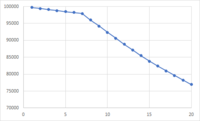
What is interesting is that this leads to 76.9% Survival Rate, which is better than your 13% + 7% + 6% = 26% mortality. This is due to the mixed effects of one cause striking first and the same cause not being able to strike a second time. One patient cannot succumb two times. Obviously, the deaths in the first 7 days are "Other". It's not as clear, after that.
Note: With multiple decrements, you MUST account for the interactions and the sequential nature of the problem. It is not appropriate simply to apply the given risk percentages in their own isolated vacuums.



