
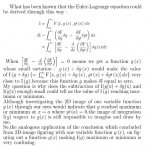
I can derive the Euler-Lagrange equation in variation method while the reason,which I learned from some sources,for why Eular-Lagrange equation figured out the maximum or minimum of the integration is not very convincing.Detailed description shown in the image.
. . .\(\displaystyle \mbox{What has been known that the Euler-Lagrange equation could}\)
\(\displaystyle \mbox{be derived through this way:}\)
. . . . .\(\displaystyle \displaystyle \begin{align}I\, &=\, \int_{x_0}^{x_1}\, F\, [x,\, g(x),\, g'(x)]\, dx
\\ \\ \delta I\, &=\, \int_{x_0}^{x_1}\, \left( \dfrac{\partial F}{\partial g}\, \delta g\, +\, \dfrac{\partial F}{\partial g'}\, \delta g' \right)\, dx
\\ \\ &=\, \int_{x_0}^{x_1}\, \left[ \dfrac{\partial F}{\partial g}\, -\, \dfrac{d}{dx}\, \left(\dfrac{\partial F}{\partial g'}\right)\right]\, \delta g(x)\, dx \end{align}\)
. . .\(\displaystyle \mbox{When }\, \left[ \dfrac{\partial F}{\partial g}\, -\, \dfrac{d}{dx}\, \left(\dfrac{\partial F}{\partial g'}\right)\right]\, =\, 0\, \mbox{ means we get a func}\mbox{tion }\, g(x)\)
\(\displaystyle \mbox{whose small variation: }\, g(x)\, +\, \delta g(x)\, \mbox{ would make the value}\)
\(\displaystyle \mbox{of }\, I\, (g\, +\, \delta g)\, \{=\, \int_{x_0}^{x_1}\, F\, [x,\, g(x)\, +\, \delta g(x),\, g'(x)\, +\, \delta g'(x)]\, dx \}\, \mbox{ very}\)
\(\displaystyle \mbox{close to }\, I(g),\, \mbox{ because this fun}\mbox{ction }\, g\, \mbox{ makes }\, \delta I\, \mbox{ equal to zero.}\)
\(\displaystyle \mbox{My question is why does the subtraction of }\, I(g(x)\, +\, \delta g(x)\, \mbox{ and}\)
\(\displaystyle I(g(x)\, \mbox{ enough small could tell us the value of }\, I(g)\, \mbox{reaching max-}\)
\(\displaystyle \mbox{imum or minimum.}\)
. . .\(\displaystyle \mbox{Although investigating the 2D image of one variable func}\mbox{tion}\)
\(\displaystyle y(x)\, \mbox{ through our eyes would indicate that }\, y\, \mbox{ reached maximum}\)
\(\displaystyle \mbox{or minimum at }\, x\, =\, a\, \mbox{ where }\, y'(a)\, =\, 0,\, \mbox{ the image of integration}\)
\(\displaystyle I(g)\, \mbox{ respect to }\, g(x)\, \mbox{ is still impossible to imagine and draw by}\)
\(\displaystyle \mbox{me.}\)
. . .\(\displaystyle \mbox{So, the analogous application of the conclusion which concluded}\)
\(\displaystyle \mbox{from 2D-image figuring with one variable func}\mbox{tion }\, y(x),\, \mbox{ on fig-}\)
\(\displaystyle \mbox{uring out a func}\mbox{tion }\, g(x)\, \mbox{ making }\, I(g)\, \mbox{maximum or minimum is}\)
\(\displaystyle \mbox{very confusing.}\)
. . .\(\displaystyle \mbox{What has been known that the Euler-Lagrange equation could}\)
\(\displaystyle \mbox{be derived through this way:}\)
. . . . .\(\displaystyle \displaystyle \begin{align}I\, &=\, \int_{x_0}^{x_1}\, F\, [x,\, g(x),\, g'(x)]\, dx
\\ \\ \delta I\, &=\, \int_{x_0}^{x_1}\, \left( \dfrac{\partial F}{\partial g}\, \delta g\, +\, \dfrac{\partial F}{\partial g'}\, \delta g' \right)\, dx
\\ \\ &=\, \int_{x_0}^{x_1}\, \left[ \dfrac{\partial F}{\partial g}\, -\, \dfrac{d}{dx}\, \left(\dfrac{\partial F}{\partial g'}\right)\right]\, \delta g(x)\, dx \end{align}\)
. . .\(\displaystyle \mbox{When }\, \left[ \dfrac{\partial F}{\partial g}\, -\, \dfrac{d}{dx}\, \left(\dfrac{\partial F}{\partial g'}\right)\right]\, =\, 0\, \mbox{ means we get a func}\mbox{tion }\, g(x)\)
\(\displaystyle \mbox{whose small variation: }\, g(x)\, +\, \delta g(x)\, \mbox{ would make the value}\)
\(\displaystyle \mbox{of }\, I\, (g\, +\, \delta g)\, \{=\, \int_{x_0}^{x_1}\, F\, [x,\, g(x)\, +\, \delta g(x),\, g'(x)\, +\, \delta g'(x)]\, dx \}\, \mbox{ very}\)
\(\displaystyle \mbox{close to }\, I(g),\, \mbox{ because this fun}\mbox{ction }\, g\, \mbox{ makes }\, \delta I\, \mbox{ equal to zero.}\)
\(\displaystyle \mbox{My question is why does the subtraction of }\, I(g(x)\, +\, \delta g(x)\, \mbox{ and}\)
\(\displaystyle I(g(x)\, \mbox{ enough small could tell us the value of }\, I(g)\, \mbox{reaching max-}\)
\(\displaystyle \mbox{imum or minimum.}\)
. . .\(\displaystyle \mbox{Although investigating the 2D image of one variable func}\mbox{tion}\)
\(\displaystyle y(x)\, \mbox{ through our eyes would indicate that }\, y\, \mbox{ reached maximum}\)
\(\displaystyle \mbox{or minimum at }\, x\, =\, a\, \mbox{ where }\, y'(a)\, =\, 0,\, \mbox{ the image of integration}\)
\(\displaystyle I(g)\, \mbox{ respect to }\, g(x)\, \mbox{ is still impossible to imagine and draw by}\)
\(\displaystyle \mbox{me.}\)
. . .\(\displaystyle \mbox{So, the analogous application of the conclusion which concluded}\)
\(\displaystyle \mbox{from 2D-image figuring with one variable func}\mbox{tion }\, y(x),\, \mbox{ on fig-}\)
\(\displaystyle \mbox{uring out a func}\mbox{tion }\, g(x)\, \mbox{ making }\, I(g)\, \mbox{maximum or minimum is}\)
\(\displaystyle \mbox{very confusing.}\)
Attachments
Last edited by a moderator: