Are my answers correct?
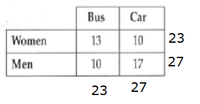
The table shows how persons travel to work. Each person used only one form of transport.
(a) What is the probability that the person who arrives to work:
(i) is a man = 27/50
(ii) travelled by bus = 23/50
(iii) is a women and travelled by car = 10/50
(b) Some travelled to work by bus. What is the probability that person is a woman? =13/23
(c) Two people arrive to work, one after the other. What is the probability that they:
(i) both travelled by car =
I used the addition and multiplication rule: P(W,W) or P(M,M) or P(M,W) or (W,M)
(10/27x10/27)+(17/27x17/27)+(17/27x10/27)^2 =0.5879
(ii) are male and female, in any order
I did the same as in part (i). P(M,W) or P(W,M) or P(M,W) or P(W,M). The first two are for the bus and the remaining are for car.
(10/23x13/23)^2 + (17/27x10/27)^2 = 0.1147
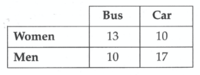
The table shows how persons travel to work. Each person used only one form of transport.
(a) What is the probability that the person who arrives to work:
(i) is a man = 27/50
(ii) travelled by bus = 23/50
(iii) is a women and travelled by car = 10/50
(b) Some travelled to work by bus. What is the probability that person is a woman? =13/23
(c) Two people arrive to work, one after the other. What is the probability that they:
(i) both travelled by car =
I used the addition and multiplication rule: P(W,W) or P(M,M) or P(M,W) or (W,M)
(10/27x10/27)+(17/27x17/27)+(17/27x10/27)^2 =0.5879
(ii) are male and female, in any order
I did the same as in part (i). P(M,W) or P(W,M) or P(M,W) or P(W,M). The first two are for the bus and the remaining are for car.
(10/23x13/23)^2 + (17/27x10/27)^2 = 0.1147