
Continuity at x = 0: g(x) = x^2 for x <= 0, sqrt[x] for x > 0

dsfrankl

New member
Joined
Sep 20, 2016
Messages
1
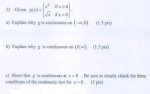
\(\displaystyle \mbox{2) Given }\, g(x)\, =\, \begin{cases}x^2&\mbox{if }\, x\, \leq\, 0 \\ \sqrt{\strut x\,}&\mbox{if }\, x\, >\, 0\end{cases}\)

\(\displaystyle \mbox{a) Explain why }\, g\, \mbox{ is continuous on }\, (-\infty,\, 0).\)

\(\displaystyle \mbox{b) Explain why }\, g\, \mbox{ is continuous on }\, (0,\, \infty).\)

\(\displaystyle \mbox{c) Show that }\, g\, \mbox{ is continuous at }\, x\, =\, 0.\, \mbox{ Be sure to clearly}\)

. .\(\displaystyle \mbox{check the three conditions of the continuity test for }\, x\, =\, 0.\)

I can solve the 3rd part of this question, (determining if it's continuous at x=0), but the first two parts are throwing me off with specific points. My professor said there should be sentences explaining this as the answer but I'm lost.
 

Attachments
  • continuity.jpg
    continuity.jpg
    14.8 KB · Views: 8
Last edited by a moderator:
\(\displaystyle \mbox{2) Given }\, g(x)\, =\, \begin{cases}x^2&\mbox{if }\, x\, \leq\, 0 \\ \sqrt{\strut x\,}&\mbox{if }\, x\, >\, 0\end{cases}\)

\(\displaystyle \mbox{a) Explain why }\, g\, \mbox{ is continuous on }\, (-\infty,\, 0).\)

\(\displaystyle \mbox{b) Explain why }\, g\, \mbox{ is continuous on }\, (0,\, \infty).\)

\(\displaystyle \mbox{c) Show that }\, g\, \mbox{ is continuous at }\, x\, =\, 0.\, \mbox{ Be sure to clearly}\)

. .\(\displaystyle \mbox{check the three conditions of the continuity test for }\, x\, =\, 0.\)

I can solve the 3rd part of this question, (determining if it's continuous at x=0), but the first two parts are throwing me off with specific points. My professor said there should be sentences explaining this as the answer but I'm lost.
\(\displaystyle {\displaystyle{ \lim _{x \to {0^ - }}}g(x) = {\lim _{x \to {0^ + }}}g(x)} = g(0) = 0\)
 
Last edited by a moderator:
\(\displaystyle \mbox{2) Given }\, g(x)\, =\, \begin{cases}x^2&\mbox{if }\, x\, \leq\, 0 \\ \sqrt{\strut x\,}&\mbox{if }\, x\, >\, 0\end{cases}\)

\(\displaystyle \mbox{a) Explain why }\, g\, \mbox{ is continuous on }\, (-\infty,\, 0).\)

\(\displaystyle \mbox{b) Explain why }\, g\, \mbox{ is continuous on }\, (0,\, \infty).\)

\(\displaystyle \mbox{c) Show that }\, g\, \mbox{ is continuous at }\, x\, =\, 0.\, \mbox{ Be sure to clearly}\)

. .\(\displaystyle \mbox{check the three conditions of the continuity test for }\, x\, =\, 0.\)

I can solve the 3rd part of this question, (determining if it's continuous at x=0), but the first two parts are throwing me off with specific points. My professor said there should be sentences explaining this as the answer but I'm lost.
The answer sort of depends on what is allowed by your professor. For example, for part (a)you might have "f(x)=x2 is a well known continuous function on (\(\displaystyle -\infty,\, \infty\)) since it meets the three conditions for continuity for any finite x. Therefore x2 is continuous on the sub-interval (\(\displaystyle -\infty,\, 0\)]" and a similar statement for \(\displaystyle \sqrt{x}\).

Or, you might need to prove each individually:
Let \(\displaystyle x\, =\, x_0 \, \varepsilon\, (-\infty,\, 0]\, \text{and an }\epsilon \gt\, 0. ...\)

From what you 'said', I suspect the former is sufficient but no guarantees.
 
Last edited by a moderator:
Top