
You are using an out of date browser. It may not display this or other websites correctly.
You should upgrade or use an alternative browser.
You should upgrade or use an alternative browser.
Continuity discussion
- Thread starter User16
- Start date
If we have x+y=k (a constant), then you just have the function at one point, but, as possibly you meant, x+y=k is the family of curves with parameter (variable) k then we still havef(x+y)= (x+y)! , f being a function on the domain R where R consists of all the lines x+y=constant=k (say)
Can anyone discuss the continuity of the function f on the domain R in details ?
f(k) = k!
but now k varies and we have a function of k. The familiar factorial function defined on the non-negative integers can be extended, see
http://en.wikipedia.org/wiki/Gamma_function
for example:

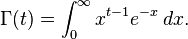
The gamma function is defined for all complex numbers except the negative integers and zero. For complex numbers with a positive real part, it is defined via a convergent improper integral:
If we have x+y=k (a constant), then you just have the function at one point, but, as possibly you meant, x+y=k is the family of curves with parameter (variable) k then we still have
f(k) = k!
but now k varies and we have a function of k. The familiar factorial function defined on the non-negative integers can be extended, see
http://en.wikipedia.org/wiki/Gamma_function
for example:
Thank you for the help
