
You are using an out of date browser. It may not display this or other websites correctly.
You should upgrade or use an alternative browser.
You should upgrade or use an alternative browser.
convergence of sequences
- Thread starter SemperFi
- Start date




HallsofIvy
Elite Member
- Joined
- Jan 27, 2012
- Messages
- 7,760
You do not say that \(\displaystyle a= \sum a_n\) although that appears to be what you mean.
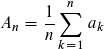
View attachment 4601
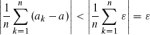
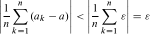
How can I prove, that if (an) converges, (An) also converges, and View attachment 4602?
Thank you very much!
Saw something a long time ago which reminded me of that. Had to go look it up, just couldn't remember the name of it - Cesàro summation [in this case the ak would themselves be a partial sum and if those partial sums converged, the Cesàro sum converged to the same thing].
Just talking through an outline of the proof, without an actual proof, seems like we would have something like, if ak converges to a then
An = \(\displaystyle \frac{1}{n} \Sigma_{k=1}^{k=n} a_k\) ~ \(\displaystyle \frac{1}{n} \Sigma_{k=1}^{k=m} a_k + \frac{n-m}{n} a = \frac{1}{n} \Sigma_{k=1}^{k=m} a_k - \frac{m}{n} a + a\)
or, as n goes to infinity, that fixed summation up to m which is divided by n and the m/n term go to zero so that An goes to a
Now if one could put that on a firm foundation, seems like they would have a proof.
... Does that work?
Not quite but almost. Consider the sequence
{ak}={10000, 1, 1, 1, 1, 1, ...}
Not all |ak - a| are less than epsilon. However there is some m for which that is true for all k > m and, given epsilon, m can be fixed.
