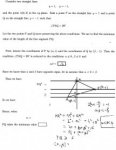
Alright, I'm having a bit of trouble following your work, but I think I understand. You've established three points: \(\displaystyle A\left(0,3\right);\

\left(\alpha ,1\right);\:Q\left(\beta ,-1\right)\). You've also determined that in order for angle PAQ to be 90 degrees, \(\displaystyle \alpha \cdot \beta =-8\). So, now it's just a matter of applying the Pythagorean theorem:
\(\displaystyle \left(PQ\right)^2=\left(PA\right)^2+\left(QA\right)^2\)
\(\displaystyle \left(PA\right)^2=\left(0-\alpha \right)^2+\left(3-1\right)^2\)
\(\displaystyle \left(QA\right)^2=\left(0-\beta \right)^2+\left(3-\left(-1\right)\right)^2\)
\(\displaystyle \left(PQ\right)^2=\alpha ^2+2^2+\beta ^2+4^2\)
I'm with you up to this point. After this, you start to go sideways. By what logic have you decided this next step:
\(\displaystyle \left(PQ\right)^2=20+\left(\alpha +\beta \right)^2+16\)
In particular, how can the two constant terms (that is 2
2 + 4
2) become 20 + 16? And how does \(\displaystyle \alpha ^2+\beta ^2=\left(\alpha +\beta \right)^2\)? Think about this: You can plainly see that \(\displaystyle 2^2+3^2\ne \left(2+3\right)^2\) because 4 + 9 (13) does not equal 5
2 (25).