
You are using an out of date browser. It may not display this or other websites correctly.
You should upgrade or use an alternative browser.
You should upgrade or use an alternative browser.
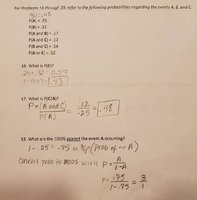
Could anyone tell me if I did these correctly!?
- Thread starter Sharnice
- Start date

Harry_the_cat
Elite Member
- Joined
- Mar 16, 2016
- Messages
- 3,779
Looks good to me. I'd just state the odds as "3 to 1".

Dr.Peterson
Elite Member
- Joined
- Nov 12, 2017
- Messages
- 16,974
I get a different result for 16, using the facts about A and C and A or C.
I agree that 3:1 is better than 3/1, but that depends on how you are taught to write odds.
I agree that 3:1 is better than 3/1, but that depends on how you are taught to write odds.
Harry_the_cat
Elite Member
- Joined
- Mar 16, 2016
- Messages
- 3,779
Yes Dr P is correct.
I made the same mistake that I think you (Sharnice) did, ie assumed that A, Band C were the only options and so P(A)+P(B)+P(C)=1.
But that is not consistent with the values given for P(A and C) and P(A or C).
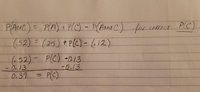
Use the fact that P(A or C) = P(A) +P(C) - P(A and C) to calculate the correct value of P(C).
I made the same mistake that I think you (Sharnice) did, ie assumed that A, Band C were the only options and so P(A)+P(B)+P(C)=1.
But that is not consistent with the values given for P(A and C) and P(A or C).
Use the fact that P(A or C) = P(A) +P(C) - P(A and C) to calculate the correct value of P(C).
Dr.Peterson
Elite Member
- Joined
- Nov 12, 2017
- Messages
- 16,974
Correct. You could also do it using a Venn diagram.
thank you!
Correct. You could also do it using a Venn diagram.
I have a question. I didn't notice it last night. for number 16, why isn't the value for P(B and C) =.14 used in the equation to find what P(C) is?Correct. You could also do it using a Venn diagram.
I have a question. I didn't notice it last night. for number 16, why isn't the value for P(B and C) =.14 used in the equation to find what P(C) is?Yes Dr P is correct.
I made the same mistake that I think you (Sharnice) did, ie assumed that A, Band C were the only options and so P(A)+P(B)+P(C)=1.
But that is not consistent with the values given for P(A and C) and P(A or C).
Use the fact that P(A or C) = P(A) +P(C) - P(A and C) to calculate the correct value of P(C).
Dr.Peterson
Elite Member
- Joined
- Nov 12, 2017
- Messages
- 16,974
I have a question. I didn't notice it last night. for number 16, why isn't the value for P(B and C) =.14 used in the equation to find what P(C) is?
Because we don't also know P(B or C), or anything else that could combine with this fact to help us toward that goal.
There are 8 regions in a Venn diagram, so in general you need 8 equations (or given facts) to fully determine the diagram. This problem doesn't allow us to find everything that could be asked, including for example P(B only).
okay got it!Because we don't also know P(B or C), or anything else that could combine with this fact to help us toward that goal.
There are 8 regions in a Venn diagram, so in general you need 8 equations (or given facts) to fully determine the diagram. This problem doesn't allow us to find everything that could be asked, including for example P(B only).