Anne-Cathrine
New member
- Joined
- Dec 30, 2016
- Messages
- 2
Hi there 
I have some trouble with this task:
"A curve in space is given by:
I have attached a picture showing how I solved it, but the answer in the assignment is not the one I get. I get the correct answer, but I can't figure out how it is the same as the exspression in the multible choice assignment.

I have written my calculations and my answer in blue and the answer in the assignment in red. (I don't know why it's upside-down?? )
Thank you in advance! :grin:
I have some trouble with this task:
"A curve in space is given by:
x = cos(2t)
y = sin(2t)
z = 2ln(t)
where the parameter t "passes through" the positive real numbers. Mark the correct exspression for the arc lenght from t = 1 to t = 2"y = sin(2t)
z = 2ln(t)
I have attached a picture showing how I solved it, but the answer in the assignment is not the one I get. I get the correct answer, but I can't figure out how it is the same as the exspression in the multible choice assignment.
I have written my calculations and my answer in blue and the answer in the assignment in red.
(I don't know why it's upside-down?? )Thank you in advance! :grin:
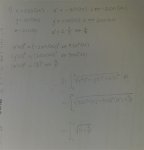
![20161230_194934[1].jpg](/forum/data/attachments/5/5697-0295c49e79e79f43772f521144952af9.jpg)