
Definite integral problem

cosmic

Junior Member
Joined
Mar 3, 2014
Messages
84
Hi guys,

This question is driving me crazy! :(

I need to find the definite integral from pi/4 to pi/3 of x cos (4x) by using integration by parts. Hence I need the area in 4 d.p. I've managed to get the answer 3/32-(pi sqrt(3))/24 which is approximately -0.132975. Can someone please point me in the right direction. I've spent all day checking it just don't know what I'm doing wrong.

Thanks in advance. :)
 
Hi guys,

This question is driving me crazy! :(

I need to find the definite integral from pi/4 to pi/3 of x cos (4x) by using integration by parts. Hence I need the area in 4 d.p. I've managed to get the answer 3/32-(pi sqrt(3))/24 which is approximately -0.132975. Can someone please point me in the right direction. I've spent all day checking it just don't know what I'm doing wrong.

Thanks in advance. :)
What did you get as anti-derivative of:

\(\displaystyle \displaystyle{x * cos(4x)}\)
 
What did you get as anti-derivative of:

\(\displaystyle \displaystyle{x * cos(4x)}\)

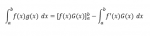
I used the following formula:

1.PNG

The values I got were f(x)=x, g(x)=cos (4x), f'(x)=1 and G(x)=1/4sin(4x).

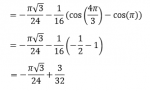
I think I know where I went wrong. I get to the final stage where I have:

2.PNG
But I know that's wrong. Can you see where I went wrong?
 
I used the following formula:

View attachment 4217

The values I got were f(x)=x, g(x)=cos (4x), f'(x)=1 and G(x)=1/4sin(4x).

I think I know where I went wrong. I get to the final stage where I have:

View attachment 4218
But I know that's wrong. Can you see where I went wrong?

View attachment 4217
The formula above is incorrect. Correct formula is

\(\displaystyle \displaystyle{\int u(x) * d[v(x)] \ = \ u(x) * v(x) - \int v(x) * d[u(x)]} \)

In your case:

u(x) = x → d[u(x)] = dx

d[v(x] = cos(4x) dx → v(x) = \(\displaystyle \frac{sin(4x)}{4}\)
 
View attachment 4217
The formula above is incorrect. Correct formula is

\(\displaystyle \displaystyle{\int u(x) * d[v(x)] \ = \ u(x) * v(x) - \int v(x) * d[u(x)]} \)

In your case:

u(x) = x → d[u(x)] = dx

d[v(x] = cos(4x) dx → v(x) = \(\displaystyle \frac{sin(4x)}{4}\)

I'm sure the formula's correct. That's the notation used in my textbook.
 
I'm sure the formula's correct. That's the notation used in my textbook.

You are surely incorrect!!

Follow the instructions I had posted and you'll arrive at the correct answer.
 
I'm sure the formula's correct. That's the notation used in my textbook.

You are surely incorrect!!

Follow the instructions I had posted and you'll arrive at the correct answer.
The two formulas
\(\displaystyle \int_a^b f(x)g(x)dx= \left[f(x)G(x)\right]_a^b- \int_a^b f'(x)G(x)dx\)
(where, I presume, G(x) is an anti-derivative of g()- G'(x)= g(x))
and
\(\displaystyle \int u(x)d(v(x))= uv- \int v(x)d(u(x))\)

are exactly the same with u= f(x) and \(\displaystyle d(v(x))= g(x)dx\)

As JohnZ pointed out, your error is that \(\displaystyle cos(\pi)= -1\) so that \(\displaystyle cos(\frac{4\pi}{3})- cos(\pi)= -\frac{1}{2}- (-1)= \frac{1}{2}\) not \(\displaystyle -\frac{3}{2}\).
 
Last edited:
Thanks guys. :)

As John said I had missed out a negative sign.:lol: But the notation I used was correct.
 
Top