
Derivative help

bobby2345

New member
Joined
Sep 12, 2015
Messages
3
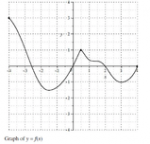
a. Estimate x for which f'(x)=0 ,
b. Find all points for which f'(x) does not exist.
c. Estimate f'(x) at the points where it is greatest or least.
d. Estimate f'(x) for x=-3,-2,-1,0,1,2,3
e. Sketch the graph of f'(x)

Graph of f(x):

attachment.php


My thoughts:

a. x=-2,3. When the tangent line is a horizontal line. So, thats when x=-2 and 3.
b. were the x values don't exist but i don't know how to get them by using f(x) graph
If you can graph f'(x), i can mostly solve all of it.
Thanks ...
 

Attachments

  • 2eft44i_th.png
    2eft44i_th.png
    23.2 KB · Views: 20
Graph of f(x):

attachment.php


a. Estimate x for which f'(x)=0 ,

My thoughts:

a. x=-2,3. When the tangent line is a horizontal line. So, thats when x=-2 and 3.
The graph is too small for me to make out the numbers on the axes, but if you're referring to the local minima, then I agree with your solution values, so far. But there appears to be another point at which the derivative is probably zero.

b. Find all points for which f'(x) does not exist.

My thoughts:

b. were the x values don't exist but i don't know how to get them by using f(x) graph
Think about the definition of the derivartive. In particular, how does the derivative relate to the limit values from the left and the right? If those limit values from the sides are not the same, does "the limit" exist? Can the derivative then exist?

c. Estimate f'(x) at the points where it is greatest or least.
Since the derivative is the slope at the point, this is asking you to estimate the x-values at which the slope is the steepest.

d. Estimate f'(x) for x=-3,-2,-1,0,1,2,3
Sketch a line on the graph for each x-value, showing what appears (to you) to be a good match to the tangent line at that point. Extend these little line segments until they're long enough that you can pick a couple of points on each line. These the pairs of points to estimate the slope at each graphed point, and thus the value of the derivative at each point.

e. Sketch the graph of f'(x)
Where is the derivative equal to zero? Graph those zeroes on the x-axis of your graph of the derivative.

Where is the function increasing? What is the sign of the derivative on these intervals? Where is the function decreasing? What is the sign of the derivative on these intervals? What were the derivative estimates you got (in part (d) above) for the specified x-values? Plot these points, making sure they match well with the intervals of sign that you noted. Remember to use a vertical asymptote at the undefined point. Then rough in the rest of the graph. ;)
 
< tinypic URL removed >

Bigger picture of graph.

For c) would you say it would be x=0,0.5?
 
Last edited by a moderator:
Top