
Determine the intervals on which the function is continuous

Nicolas5150

New member
Joined
Jan 15, 2014
Messages
5
I seem to be having some issues on how to approach these problems.
I understand the concept behind not being able to have 0/0. Therefore any breaks where x causes the denominator to equal zero would be a discontinuity in the graph.
Most of the problems I have done have had a polynomial where I could factor and then clearly see any denominator values that cause a zero.
If anyone could help assist me in the problems or even get me on the right track it would be most appreciated.
Determine the intervals on which the function is continuous; support each with a graph.

IMG_2431.jpg
IMG_2432.jpg
 
I seem to be having some issues on how to approach these problems.
I understand the concept behind not being able to have 0/0. Therefore any breaks where x causes the denominator to equal zero would be a discontinuity in the graph.
Most of the problems I have done have had a polynomial where I could factor and then clearly see any denominator values that cause a zero.
If anyone could help assist me in the problems or even get me on the right track it would be most appreciated.
Determine the intervals on which the function is continuous; support each with a graph.
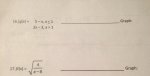
View attachment 3734
View attachment 3735
You need to MEMORIZE the conditions that determine whether a function is continuous at a specific value.

Your f(a) = 0/0 example indicates that the function is not a real number (does not exist) if x = a. But existence is just one of the four conditions required.

\(\displaystyle f(x)\ is\ continuous\ at\ x = a \iff \)

\(\displaystyle (I)\ f(a)\ exists;\ (II)\ \displaystyle \lim_{x \rightarrow a^-}f(x)\ exists;\ (III)\ \lim_{x \rightarrow a^+}f(x)\ exists;\ and\ (IV)\ \lim_{x \rightarrow a^-}f(x) = f(a) =\lim_{x \rightarrow a^+}f(x).\)

Now let me get you started on # 16. It is almost intuitive that g(x) exists at every value of x, but you can prove it if you like. Furthermore, it is not difficult to show that if x < 1 or x > 1, the various limits exist, etc. The question becomes whether all four conditions are met if x = 1.

When the problem asks you to specify the interval or intervals over which f(x) is continuous, you do not need to give a formal proof. It will usually be pretty obvious what the answer is except at a few points. In problem 16, it is obvious except at 1 because the formula for the function changes there. So you need to test all four conditions at such points.

Make sense?
 
Top