
Find Extremum using first derivative test

Maddy_Math

New member
Joined
Jun 10, 2013
Messages
28
hey guys I tried to find extrema with the help of first derivative test, but there is a problem. I found one point successfully but the other point is giving me trouble. According to the notes my answer should be x = 2 and x = 0 BUT my answer is x = 2 and x = undefined

I have attached my calculation please tell me where am I going wrong, and please don't comment about my stylus skills I know it's too worse
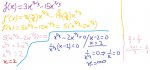
find-extremum.jpg

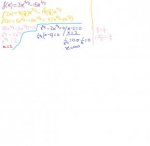
sorry pic quality in previous upload was bad - idk why but in my comp it was ok well but now I have uploaded an already jpg converted file
 

Attachments
  • find-extremum.jpg
    find-extremum.jpg
    7.5 KB · Views: 3
Last edited:
critical points are the point x such that : 1) f'(x)=0 2) f'(x) does not exist.
 
hey guys I tried to find extrema with the help of first derivative test, but there is a problem. I found one point successfully but the other point is giving me trouble. According to the notes my answer should be x = 2 and x = 0 BUT my answer is x = 2 and x = undefined
What do you mean by "x= undefined"?? There is no value of x that makes \(\displaystyle \frac{1}{x^{1/3}}\) equal to zero but that is NOT the same as saying "x is undefined".

I have attached my calculation please tell me where am I going wrong, and please don't comment about my stylus skills I know it's too worse

View attachment 4230

sorry pic quality in previous upload was bad - idk why but in my comp it was ok well but now I have uploaded an already jpg converted file
The first derivative reduces to \(\displaystyle 5x^{2/3}- 10x^{-1/3}\)
There one value of x that makes that 0 and another that makes the derivative undefined. But that value of x is well defined!
 
Last edited:
What do you mean by "x= undefined"?? There is no value of x that makes \(\displaystyle \frac{1}{x^{1/3}}\) equal to zero but that is NOT the same as saying "x is undefined".


The first derivative reduces to \(\displaystyle 5x^{2/3}- 10x^{-1/3}\)
There one value of x that makes that 0 and another that makes the derivative undefined. But that value of x is well defined!

\(\displaystyle \frac{1}{x^{1/3}} = 0\) doesn't this evaluate to x = undefined ??? because x is in denominator and if \(\displaystyle \frac{1}{x} = 0 \implies x = \infty \)
 
y' = [FONT=MathJax_Main]5[/FONT][FONT=MathJax_Math]x[/FONT][FONT=MathJax_Main]2[/FONT][FONT=MathJax_Main]/[/FONT][FONT=MathJax_Main]3[/FONT][FONT=MathJax_Main]−[/FONT][FONT=MathJax_Main]10[/FONT][FONT=MathJax_Math]x[/FONT][FONT=MathJax_Main]−[/FONT][FONT=MathJax_Main]1[/FONT][FONT=MathJax_Main]/[/FONT][FONT=MathJax_Main]3[/FONT]= 5x-1/3(x - 2)[FONT=MathJax_Main]10[/FONT][FONT=MathJax_Math]x[/FONT][FONT=MathJax_Main]−[/FONT][FONT=MathJax_Main]1[/FONT][FONT=MathJax_Main]/[/FONT][FONT=MathJax_Main]35[/FONT][FONT=MathJax_Main]10[/FONT][FONT=MathJax_Math]x[/FONT][FONT=MathJax_Main]−[/FONT][FONT=MathJax_Main]1[/FONT][FONT=MathJax_Main]/[/FONT][FONT=MathJax_Main]3[/FONT]

for y' = 0 at x = 2 and

at x = 0 → y' = DNE
 
\(\displaystyle \frac{1}{x^{1/3}} = 0\) doesn't this evaluate to x = undefined ??? because x is in denominator and if \(\displaystyle \frac{1}{x} = 0 \implies x = \infty \)
No, it doesn't. It "evaluates" to "there is no value of x that makes \(\displaystyle \frac{1}{x^{1/3}}= 0\)".
But where did you get "\(\displaystyle \frac{1}{x^{1/3}}= 0\)" anyway? That equation is irrelevant to this problem.
You want to determine where the derivative, \(\displaystyle 5x^{2/3}- 10x^{1/3}\), is 0 or where the derivative is not defined. There is one value of x that makes the derivative 0 and another that make the derivative "undefined".
 
if \(\displaystyle \frac{1}{x} = 0 \implies x = \infty \)

Hi Maddy:

Maybe you're confusing the equations above with limit statements that you've seen before.

The expression 1/x never equals zero, and infinity is not a number (so we cannot state that x equals infinity).

Here is what we can say. If the value of x approaches infinity, then the value of 1/x approaches zero.

Cheers :)
 
Hi Maddy:

Maybe you're confusing the equations above with limit statements that you've seen before.

The expression 1/x never equals zero, and infinity is not a number (so we cannot state that x equals infinity).

Here is what we can say. If the value of x approaches infinity, then the value of 1/x approaches zero.

Cheers :)

Oh thankyou Quaid, I'm kinda confused. well in \(\displaystyle \frac{1}{x^{1/3}}\) can we say as this expression approaches zero then x approaches infinity

and thanks to all other guys too, actually I'm confused that's why I'm here so please don't mind my stupidity
 
in \(\displaystyle \frac{1}{x^{1/3}}\) can we say as this expression approaches zero then x approaches infinity

y = 1/x^(1/3)

We could say that if y is approaching zero, then x must be approaching infinity.

Usually, the statement direction goes the other way because the expression 1/x^(1/3) represents the dependent variable (i.e., the function output is y) and so the value of y depends upon what is happening to the value of x (the independent variable).

In other words, we generally state what is happening to x first (the input), and then follow with the resulting behavior of y (the output).

If x is approaching infinity, then 1/x^(1/3) is approaching zero.

What you asked about is the inverse of the function y = 1/x^(1/3)

The inverse is x = 1/y^3

When considering this inverse relationship, then, yes, we would say that as y approaches zero, x approaches infinity, because -- in the inverse relationship -- y is now the independent variable (the input) and x is now the dependent variable (the output).

That is, when we switch to the inverse function, the roles of x and y swap.

Your exercise does not involve the inverse relationship, so you should stick with x as the input and y as the output AND y depends upon x. So, look at what x is doing first, then think about how that affect y.

As x grows without bound, y gets closer and closer to zero (from the right).

:cool:
 
Last edited:
Top