
Find the global minimum of f: R -> R^2, ||(2 1, 3 1, 4 2)(x1 x2) - (2 1 7)||_2^2

zozo222

New member
Joined
Jul 1, 2016
Messages
4
Hello, I have a question that I really have no idea how to start with.

There ist f: R -> R^2

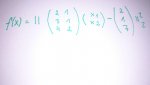
. . . . .\(\displaystyle f(x)\, =\, \left\|\, \begin{pmatrix}2&1\\3&1\\4&2\end{pmatrix} \, \left(\begin{array}{c}x_1\\x_2\end{array}\right)\, -\, \left(\begin{array}{c}2\\1\\7\end{array}\right)\, \right\|_2^2\)

and I should find the global minimum. There are no further information. I'd like to understand what it's about, it's not that I need this particular solution, I'd just like to know how to solve problems like this. I would really appreciate any help.

I've just learned that || || 22 is the 2-Norm, so there will be a sum of squared parts that I need to put under a root.
 

Attachments
  • DSC_2404.jpg
    DSC_2404.jpg
    366.7 KB · Views: 2
Last edited by a moderator:
There is f: R -> R^2

. . . . .\(\displaystyle f(x)\, =\, \left\|\, \begin{pmatrix}2&1\\3&1\\4&2\end{pmatrix} \, \left(\begin{array}{c}x_1\\x_2\end{array}\right)\, -\, \left(\begin{array}{c}2\\1\\7\end{array}\right)\, \right\|_2^2\)
I could be wrong (so if somebody else replies with something else, ignore me and listen to them), but I think the exercise typoed. Since you're plugging (x1, x2) into the operator, this must be f(x) = f(x1, x2); that is, the domain space must be R2, not just R.

...and I should find the global minimum. There are no further information. I'd like to understand what it's about, it's not that I need this particular solution, I'd just like to know how to solve problems like this. I would really appreciate any help.

I've just learned that || || 22 is the 2-Norm, so there will be a sum of squared parts that I need to put under a root.
I think (and, again, I could be wrong) that the 2-norm ("L2-norm"?) is indicated by the subscripted 2:

. . . . .\(\displaystyle \left\|(x_1,\, x_2)\right\|_2\, =\, \sqrt{\strut x_1^2\, +\, x_2^2\,}\)

...and the superscripted 2 indicates squaring:

. . . . .\(\displaystyle \left\|(x_1,\, x_2)\right\|_2^2\, =\, \left(\,\left\|(x_1,\, x_2)\right\|_2\,\right)^2 =\, \left(\, \sqrt{\strut x_1^2\, +\, x_2^2\,}\,\right)^2\, =\, x_1^2\, +\, x_2^2\)

So, if we rename variables for convenience, we have:

. . . . .\(\displaystyle \begin{pmatrix}2&1\\3&1\\4&2\end{pmatrix} \, \left(\begin{array}{c}x\\y\end{array}\right)\, -\, \left(\begin{array}{c}2\\1\\7\end{array}\right)\, =\, \begin{pmatrix}2x\, +\, 1y\\3x\, +\, 1y\\4x\, +\, 2y\end{pmatrix}\, -\, \begin{pmatrix}2\\1\\7\end{pmatrix}\, =\, \begin{pmatrix}2x\, +\, y\, -\, 2\\3x\, +\, y\, -\, 1\\4x\, +\, 2y\, -\, 7\end{pmatrix}\)

. . . . .\(\displaystyle \left\|\, f(x,\, y)\, \right\|_2^2\, =\, \left\|\, \begin{pmatrix}2x\, +\, y\, -\, 2\\3x\, +\, y\, -\, 1\\4x\, +\, 2y\, -\, 7\end{pmatrix}\, \right\|_2^2\, =\, (2x\, +\, y\, -\, 2)^2\, +\, (3x\, +\, y\, -\, 1)^2\, +\, (4x\, +\, 2y\, -\, 7)^2\)

Does this look somewhat similar to what your book and class notes show for similar examples? If not, from what example(s) are you working? What have you done so far? Where are you stuck?

Please be complete. Thank you! ;)
 
Hello, thank you for taking your time!

I had to wait till the thread gets accepted, looked up for my very old matrice notes and got to the same results you have. The only question is: shouldn't the result be squared?

Now I suppose I need to partially differentiate, am I right? do I differentiate as if the square wasn't there?
 
Sorry, I obviously meant rooted, not squared. Now I see why there's no root in there. After I partially differentiate, can I just set it to =0 and so get to know what my critical points are? How do I know if it's a minimum or a maximum?

We actually haven't done any examples so far.

Thank you once again for taking your time!

EDIT: I partially differentiated, got 2 equations, set them 0, put one in the other and so I could see what my x and y are.

My last question is: how do I know if it's a Minimum or a Maximum?
 
Last edited:
Sorry, I obviously meant rooted, not squared. Now I see why there's no root in there. After I partially differentiate, can I just set it to =0 and so get to know what my critical points are? How do I know if it's a minimum or a maximum?

We actually haven't done any examples so far.

Thank you once again for taking your time!

EDIT: I partially differentiated, got 2 equations, set them 0, put one in the other and so I could see what my x and y are.

My last question is: how do I know if it's a Minimum or a Maximum?
Just like there is a second derivative test in functions of one variable [f'(x0)=0: f''(x0) > 0 implies maximum, f''(x0) <0 implies minimum, f''(x0)=0 then inclusive], there is a second derivative test for functions of two variables. Fro example, see
http://math.oregonstate.edu/home/pr...usQuestStudyGuides/vcalc/min_max/min_max.html
 
Top