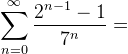
A amj New member Joined Nov 1, 2017 Messages 2 Nov 1, 2017 #1 Find the sum of the series. I'm pretty sure this is a geometric series, but I'm having trouble rewriting it in the proper form. Thanks for the help.
Find the sum of the series. I'm pretty sure this is a geometric series, but I'm having trouble rewriting it in the proper form. Thanks for the help.
tkhunny Moderator Staff member Joined Apr 12, 2005 Messages 11,325 Nov 1, 2017 #2 If that is a Geometric Series, please state the Common Ratio.
K ksdhart2 Senior Member Joined Mar 25, 2016 Messages 1,297 Nov 1, 2017 #3 amj said: Find the sum of the series. \(\displaystyle \displaystyle \sum_{n=0}^{\infty} \dfrac{2^{n-1}-1}{7^n}\) I'm pretty sure this is a geometric series, but I'm having trouble rewriting it in the proper form. Thanks for the help. Click to expand... I'd begin by dividing it into two sums: \(\displaystyle \displaystyle \sum_{n=0}^{\infty} \dfrac{2^{n-1}-1}{7^n} = \sum_{n=0}^{\infty} \dfrac{2^{n-1}}{7^n} - \sum_{n=0}^{\infty} \dfrac{1}{7^n}\) Then pull out a 7 from the denominator of the first series: \(\displaystyle \displaystyle = \dfrac{1}{7} \cdot \sum_{n=0}^{\infty} \dfrac{2^{n-1}}{7^{n-1}} - \sum_{n=0}^{\infty} \dfrac{1}{7^n}\) Can you finish up from here?
amj said: Find the sum of the series. \(\displaystyle \displaystyle \sum_{n=0}^{\infty} \dfrac{2^{n-1}-1}{7^n}\) I'm pretty sure this is a geometric series, but I'm having trouble rewriting it in the proper form. Thanks for the help. Click to expand... I'd begin by dividing it into two sums: \(\displaystyle \displaystyle \sum_{n=0}^{\infty} \dfrac{2^{n-1}-1}{7^n} = \sum_{n=0}^{\infty} \dfrac{2^{n-1}}{7^n} - \sum_{n=0}^{\infty} \dfrac{1}{7^n}\) Then pull out a 7 from the denominator of the first series: \(\displaystyle \displaystyle = \dfrac{1}{7} \cdot \sum_{n=0}^{\infty} \dfrac{2^{n-1}}{7^{n-1}} - \sum_{n=0}^{\infty} \dfrac{1}{7^n}\) Can you finish up from here?
tkhunny Moderator Staff member Joined Apr 12, 2005 Messages 11,325 Nov 1, 2017 #4 Aw, you gave it away...
A amj New member Joined Nov 1, 2017 Messages 2 Nov 2, 2017 #5 But since the lower bound of the first series is n = 0, doesn't that mean that r cannot be raised to n-1, and that it should instead be raised to n?
But since the lower bound of the first series is n = 0, doesn't that mean that r cannot be raised to n-1, and that it should instead be raised to n?
tkhunny Moderator Staff member Joined Apr 12, 2005 Messages 11,325 Nov 2, 2017 #6 It is of no consequence. |r|<1 You do the arithmetic and see what you get.