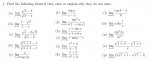
#1 asks you to find \(\displaystyle \lim_{x\to 64}\frac{\sqrt{x}- 8}{\sqrt[3]{x}- 4}\).
I presume you recognize that the first thing you should try is setting x= 64 in the expression. If the denominator did NOT become 0, then what ever you got for the fraction would be the limit. If the denominator DID become 0 and the numerator did not, you would know that limit did not exist.
But here both numerator and denominator become 0: \(\displaystyle \sqrt{64}- 8= 8- 8= 0\) and \(\displaystyle \sqrt[3]{64}- 4= 4- 4= 0\). One of the things you probably learned in algebra- and is useful here, is that if setting x equal to the number "a" makes the polynomial P(x) equal to 0 (P(a)= 0) then x- a is a factor of P(x). Here, we do not have a polynomial because of the roots. But if we let \(\displaystyle u= \sqrt[6]{x}\) then \(\displaystyle \sqrt{x}= u^3\) and \(\displaystyle \sqrt[3]{x}= u^2\).
So with that substitution, \(\displaystyle \frac{\sqrt{x}- 8}{\sqrt[3]{x}- 4}= \frac{u^3- 8}{u^2- 4}\). Clearly, x= 64 gives \(\displaystyle u= \sqrt[6]{64}= 2\) so that \(\displaystyle u^3- 8= 8- 8= 0\) and \(\displaystyle u^2- 4= 4- 4= 0\) just as before. But now we know that u- 2 divides \(\displaystyle u^3- 8\) and, doing the division, it is easy to see that \(\displaystyle u^3- 8= (u- 2)(u^2+ 2u+ 4)\). Similarly, u- 2 divides \(\displaystyle u^2- 4\): \(\displaystyle u^2- 4= (u- 4)(u+ 4)\).
Now we can write \(\displaystyle \frac{u^3- 8}{u^2- 4}= \frac{(u- 2)(u^2+ 2u+ 4)}{(u- 2)(u+ 2)}\). We can continue in either of two ways:
1) Going back to x, \(\displaystyle \frac{\sqrt{x}- 8}{\sqrt[3]{x}- 4}= \frac{(\sqrt[6]{x}- 2)(\sqrt[3](x)+ 2\sqrt[6]{x}+ 4)}{(\sqrt[6]{x}- 2)(\sqrt[6]{x}+ 2)}\).
We are taking the limit as x is going to 64 which means it is never actually equal to 64 so \(\displaystyle \sqrt[6]{x}- 2\) is never actually equal to 0 (that is important) and we can cancel that in the numerator and denominator: as long as x is not equal to 64, the fraction is \(\displaystyle \frac{\sqrt[3]{x}+ 2\sqrt[6]{x}+ 4}{\sqrt[6]{x}+ 2}\). NOW we can take x= 64 without a problem: \(\displaystyle \frac{\sqrt[3]{64}+ 2\sqrt[6]{64}+ 4}{\sqrt[6]{64}+ 2}= \frac{4+ 2(2)+ 4}{2+ 2}= \frac{12}{4}= 3\).
2) (The way I would prefer) Instead of going back to x, just recognize that as x goes to 64, \(\displaystyle u= \sqrt[6]{x}\) goes to \(\displaystyle \sqrt[6]{64}= 2\) and look at the limit \(\displaystyle \lim_{u\to 2}\frac{(u- 2)(u^2+ 2u+ 4)}{(u- 2)(u+ 2)}\). Again, since u is going to 2, it is never actually equal to 2 and we can cancel the "u- 2" in numerator and denominator: we want \(\displaystyle \lim_{u\to 2}\frac{u^2+ 2u+ 4}{u+ 2}\) which is just \(\displaystyle \frac{2^2+ 2(2)+ 4}{2+ 2}= \frac{12}{4}= 3\).
As for the problems involving trig functions, the first is \(\displaystyle \lim_{x\to 0}\frac{x}{tan(3x)}\). The first thing I would do is change to sine and cosine (always a good idea for trig functions). \(\displaystyle tan(\theta)= \frac{sin(\theta)}{cos(\theta)}\) so \(\displaystyle \frac{x}{tan(3x)}= \frac{x}{\frac{sin(3x)}{cos(3x)}}= \frac{x cos(3x)}{sin(x)}\). Now write that as \(\displaystyle \lim_{x\to 0}\frac{x}{sin(3x)} cos(3x)= \frac{1}{3}\left(\lim_{x\to 0}\frac{3x}{sin(3x)}\right)\left(\lim_{x\to 0} cos(x)\right)\). In both of those limits, let u= 3x so that as x goes to 0 so does u. The limits become \(\displaystyle o\lim_{u\to 0}\frac{1}{3}\left(\frac{u}{sin(u)}\right)\) and \(\displaystyle \lim_{u\to 0} cos(u)\). Now, there is no "easy", algebraic way to show those two last limits. You should have learned in class or from your textbook what \(\displaystyle \lim_{x\to 0}\frac{sin(x)}{x}\) and \(\displaystyle \lim_{x\to 0} cos(x)\) are.
A somewhat different idea is need for \(\displaystyle \lim_{x\to\pi}\frac{sin(x)}{x- \pi}\). Let \(\displaystyle u= x- \pi\) so that \(\displaystyle x= u+ \pi\) and, as x goes to \(\displaystyle \pi\), u goes to 0. The limit becomes \(\displaystyle \lim_{u\to 0}\frac{sin(u+ \pi)}{u}\). How can you simplify \(\displaystyle sin(u+ \pi)\)?
Finally, for something like \(\displaystyle \lim_{x\to 0}\frac{sin^2(x)}{x (1- cos(x))}\) use the fact that \(\displaystyle sin^2(x)= 1- cos^2(x)= (1- cos(x))(1+ cos(x))\).