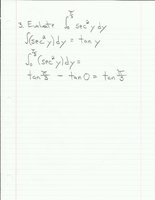
H Hckyplayer8 Full Member Joined Jun 9, 2019 Messages 269 Nov 12, 2019 #1 This one I'm pretty sure I have right. As long as one can derive the antiderivative of sec2y the rest lines up pretty nicely. My question is, what is the trick to derive sec2(y)? Just memory such as the flow of sin (x) --> cos (x) --> -sin(x) --> -cos (x) --> sin(x)?
This one I'm pretty sure I have right. As long as one can derive the antiderivative of sec2y the rest lines up pretty nicely. My question is, what is the trick to derive sec2(y)? Just memory such as the flow of sin (x) --> cos (x) --> -sin(x) --> -cos (x) --> sin(x)?
MarkFL Super Moderator Staff member Joined Nov 24, 2012 Messages 3,021 Nov 12, 2019 #3 I would continue and evaluate \(\tan\left(\dfrac{\pi}{3}\right)\) since that is a special angle.
H Hckyplayer8 Full Member Joined Jun 9, 2019 Messages 269 Nov 12, 2019 #4 Romsek said: integrate sec^2(x) Click to expand... Thank you!
H Hckyplayer8 Full Member Joined Jun 9, 2019 Messages 269 Nov 12, 2019 #5 MarkFL said: I would continue and evaluate \(\tan\left(\dfrac{\pi}{3}\right)\) since that is a special angle. Click to expand... Simplify it to sqrt(3)? Or is there more beyond that?
MarkFL said: I would continue and evaluate \(\tan\left(\dfrac{\pi}{3}\right)\) since that is a special angle. Click to expand... Simplify it to sqrt(3)? Or is there more beyond that?
MarkFL Super Moderator Staff member Joined Nov 24, 2012 Messages 3,021 Nov 12, 2019 #6 Hckyplayer8 said: Simplify it to sqrt(3)? Or is there more beyond that? Click to expand... Yes, that's all I meant.
Hckyplayer8 said: Simplify it to sqrt(3)? Or is there more beyond that? Click to expand... Yes, that's all I meant.
H Hckyplayer8 Full Member Joined Jun 9, 2019 Messages 269 Nov 12, 2019 #7 Thank you both for posting.