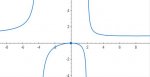
I have been asked to sketch y = x2/(x2 + 2x - 8)
According to the lesson notes it has a horizontal asymptote at y = 1 because the degree of the numerator is equal to the degree of the denominator ( said to divide the leading coefficients). However, is it really a horizontal asymptote if at least 1 part of the graph exists when y = 1. For example....in this question, when x = 4, y = 1.
When I look at the left side of the graph alone, it definitely has a horizontal asymptote of y = 1.
So can I say the graph has a horizontal asymptote at y= 1?
According to the lesson notes it has a horizontal asymptote at y = 1 because the degree of the numerator is equal to the degree of the denominator ( said to divide the leading coefficients). However, is it really a horizontal asymptote if at least 1 part of the graph exists when y = 1. For example....in this question, when x = 4, y = 1.
When I look at the left side of the graph alone, it definitely has a horizontal asymptote of y = 1.
So can I say the graph has a horizontal asymptote at y= 1?