
Help with simple problem!

rakrak1998

New member
Joined
Dec 5, 2015
Messages
11
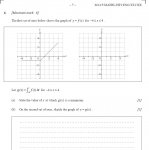
I attached the problem as an image. I understand a, the answer is x=1 because it has the most negative space under the curve.

The way i approached b was through separating the function into 2 functions. i separated it like so,

y=-1 from [-4,0]
and
y=x-1 from (0,4)

I then found the indefinite integral for both sides, but i am not sure which point MUST be on the second graph.

Any assistance is appreciated.
 

Attachments

  • mafthsf.JPG
    mafthsf.JPG
    84.1 KB · Views: 6
Well, since g(x) is the integral of f(t), I'd begin by evaluating g(x) at various values of x. Plot those points, and then you'll have a good guess of the shape of the graph. For instance:

\(\displaystyle g\left(-4\right)=\int _{-4}^{-4}\:\:f\left(t\right)dt=\int _{-4}^{-4}\:-1dt=0\)

\(\displaystyle g\left(-3\right)=\int _{-4}^{-3}\:\:f\left(t\right)dt=\int _{-4}^{-3}\:-1dt=???\)

And so on. If you've dealt with integrals of piece-wise defined functions, you know that the integral of the whole length is just the sum of the separate integrals over regions where the function is well-defined. So, to evaluate the integral when x=1, you'd have:

\(\displaystyle g\left(1\right)=\int _{-4}^1\:\:f\left(t\right)dt=\int _{-4}^0\:-1dt+\int _0^1\:\left(t-1\right)dt=???\)

When you've plotted all of the points, what do you notice? In particular, you should be able to say with certainty whether your original assumption that x=1 was the maximum of g(x) is correct.
 
I attached the problem as an image. I understand a, the answer is x=1 because it has the most negative space under the curve.

The way i approached b was through separating the function into 2 functions. i separated it like so,

y=-1 from [-4,0]
and
y=x-1 from (0,4)

I then found the indefinite integral for both sides, but i am not sure which point MUST be on the second graph.

Any assistance is appreciated.
Hint:Note that
\(\displaystyle \int_a^b\, f(x)\, dx\, =\, \int_a^c\, f(x)\, dx\, +\, \int_c^b\, f(x)\, dx\)
for any c.
 
Well, since g(x) is the integral of f(t), I'd begin by evaluating g(x) at various values of x. Plot those points, and then you'll have a good guess of the shape of the graph. For instance:

\(\displaystyle g\left(-4\right)=\int _{-4}^{-4}\:\:f\left(t\right)dt=\int _{-4}^{-4}\:-1dt=0\)

\(\displaystyle g\left(-3\right)=\int _{-4}^{-3}\:\:f\left(t\right)dt=\int _{-4}^{-3}\:-1dt=???\)

And so on. If you've dealt with integrals of piece-wise defined functions, you know that the integral of the whole length is just the sum of the separate integrals over regions where the function is well-defined. So, to evaluate the integral when x=1, you'd have:

\(\displaystyle g\left(1\right)=\int _{-4}^1\:\:f\left(t\right)dt=\int _{-4}^0\:-1dt+\int _0^1\:\left(t-1\right)dt=???\)

When you've plotted all of the points, what do you notice? In particular, you should be able to say with certainty whether your original assumption that x=1 was the maximum of g(x) is correct.

Oooohhh thank you very much i understand now! The graph of g(x) stays under the x-axis and at g(4), it goes back to zero. Thank you! :)
 
Top