Help with understanding this parameter

Tygra

New member
Joined
Mar 29, 2021
Messages
34
Hi guys,

I am tackling a question in a book of mine, a fairly tricky question. The question puts fourth a wooden mast of 15m high that tapers from 250mm diameter at the bottom to 100mm at the top. It asks at which point up the mast will it break and under what magnitude of force will it fail. The permissible stress of the wood is 35 N/mm^2.

By my calculations half the diameter d at any distance h up the mast is:

[math]d = -\frac{h}{200} + 125[/math]
The equation for the stress is:

[math]\sigma = \frac{Fh}{I}d[/math]
substituting the first equation into the second gives:

[math]\sigma = \frac{Fh}{I}(-\frac{h}{200} + 125)[/math]
Because I am 80% of the way there and got stuck I looked at the solution manual. What you have to do is differentiate the above equation and make it equal to zero to calculate the maximum direct stress.

My question is: why does equating it to zero give you the maximum direct stress?

Many thanks in advance.
 
I don't know much about stress analysis, but if the force [imath]F[/imath] is applied to the top of the mast and [imath]h[/imath] is measured from the bottom, then your formula for stress does not look right.

Also, what is [imath]I[/imath] in that formula?
 
My question is: why does equating it to zero give you the maximum direct stress?
Because derivatives of continuously differentiable functions are equal to 0 at minimum and maximum points. In you case you want to find the value [imath]h[/imath] where the stress is maximum for fixed values of [imath]F[/imath], then you might be able which value of [imath]F[/imath] will break the mast at that [imath]h[/imath].
 
Hi @blamocur,

The formula for bending stress is:

[math]\sigma = \frac{M}{I}y[/math]
Where I is the second moment of area of the section, and y is half the height of the cross-section.

M is the bending moment. Hence:

[math]M = F*h[/math]
Combining these and also the calculation for d (post #1), gives:

[math]\sigma = \frac{Fh}{I}(-\frac{h}{200} + 125)[/math]
Thank you for your response in post #3. I really should have realised that.

EDIT: I have just realised that I should have used:

[math]d = \frac{h}{200} + 50[/math]
 
Last edited:
I am still confused about 2 things:
  1. to which point is the force [imath]F[/imath] applied (I am guessing the top of the mast)
  2. where is [imath]h[/imath] measured from (I am guessing the bottom of the mast)
 
I am still confused about 2 things:
  1. to which point is the force [imath]F[/imath] applied (I am guessing the top of the mast)
  2. where is [imath]h[/imath] measured from (I am guessing the bottom of the mast)
Yes F is applied at the top of the mast, but h is also measured from the top of the mast. There is no moment at the top due to h equalling zero. This question is analogous to cantilever beam with a point load at the free end. Look at the bending moment diagram of such a case:

BMD cant beam.png
You can see the distribution of the moment across the beam: zero at the free end, maximum at the fixed support.
 
My question is: why does equating it to zero give you the maximum direct stress?
That is the condition for "extremum" of the function. I am assuming that you have "taken" and "passed" the prerequisite courses of physics and mechanics and mathematics prior to tackling this book. The exact wording of the problem would be useful. I think the problem refers to the stability of the problem (buckling) as opposed to fracture
 
Where I is the second moment of area of the section, and y is half the height of the cross-section.
What is the formula for [imath]y[/imath] ?
Is [imath]y[/imath] the same as [imath]d[/imath]? If not, how is it different?
Thanks.
 
What is the formula for yyy ?
Is yyy the same as ddd? If not, how is it different?
Thanks.
I meant to ask for the formula for [imath]I[/imath], but I've found it online since then.
And yes, [imath]y[/imath] seems to be the same as [imath]d[/imath], which you use for the radius of the beam.
I believe I've solved it, and I found it easier to solve the equation first for [imath]d[/imath] rather than for [imath]h[/imath].
 
What is the formula for [imath]y[/imath] ?
Is [imath]y[/imath] the same as [imath]d[/imath]? If not, how is it different?
Thanks.
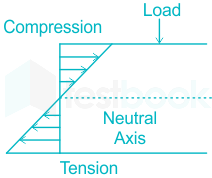
[imath]y[/imath] is the distance from the neutral axis to the edge of the cross-section. The neutral axis is the where the stress equals zero. See the image below:


neutral axis pic.png

For a symmetrical section, this is just half the distance of the cross-section ([imath]\frac{y}{2}[/imath]). If the member is asymmetrical, you have to calculate where the centroid lies and take the distance from the centroid to the outer edge. Note: this is the case for bending stress. For shear stress the maximum stress is at the neutral axis.

In the original question, the mast is circular, so [imath]y[/imath] is half the diameter.

I have solved the question now too. What values did you get? The answer is that the mast breaks 5m from the top and the force that causes failure is 2319 N.
 
Last edited:
That is the condition for "extremum" of the function. I am assuming that you have "taken" and "passed" the prerequisite courses of physics and mechanics and mathematics prior to tackling this book. The exact wording of the problem would be useful. I think the problem refers to the stability of the problem (buckling) as opposed to fracture

I have a Civil Engineering degree. In the first year we did a Structural and Stress Analysis course, and this was one of the books that was recommended to read (The book is Structural and Stress Analysis by T.H. Megson). Obviously at the time a question such as this was way beyond me. However, now being two years out of University I can complete such a problem. I have learnt that you have to be patient with yourself: the understanding will eventually come!

This is the exact wording of the question as you asked:

"A wooden mast 15m high tapers linearly from 250mm diameter at the base to 100mm at the top. At what point will the mast break under a horizontal load applied at the top? If the maximum permissible stress in the wood is 35 N/mm2, calculate the magnitude of the load that will cause failure."
 
I have solved the question now too. What values did you get? The answer is that the mast breaks 5m from the top and the force that causes failure is 2319 N.
I got the same numbers. There is a good chance that we are both right :)
 
Top