
the_beatbox_god
New member
- Joined
- Dec 23, 2015
- Messages
- 2
I have a maths assignment and I have to explain the quarks of Weddle's rule, I can't find any information on the internet so could someone please explain how it works?
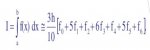
. . . . .\(\displaystyle \displaystyle I\, =\, \int_a^b\, f(x)\, dx\, \cong\, \dfrac{3h}{10}\, \bigg[\, f_0\, +\, 5\, f_1\, +\, f_2\, +\, 6\, f_3\, +\, f_4\, +\, 5\, f_5\, +\, f_6\, \bigg]\)
I very much understand how the Simpson's rule works, using parabolas to estimate the area. Is the Weddle's rule the same? Thanks in advance to anyone who can help me.
. . . . .\(\displaystyle \displaystyle I\, =\, \int_a^b\, f(x)\, dx\, \cong\, \dfrac{3h}{10}\, \bigg[\, f_0\, +\, 5\, f_1\, +\, f_2\, +\, 6\, f_3\, +\, f_4\, +\, 5\, f_5\, +\, f_6\, \bigg]\)
I very much understand how the Simpson's rule works, using parabolas to estimate the area. Is the Weddle's rule the same? Thanks in advance to anyone who can help me.
Attachments
Last edited by a moderator: