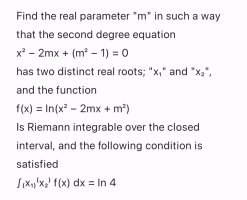
How to solve this

MasyhFarhadi

New member
Joined
Dec 17, 2025
Messages
1
1705.jpg
I'm in pre college and to make myself ready am dabbling a little in college level calculs. Today I came across this and was completely baffled. What's the answer and I would greatly appreciate if you took the time to explain how you got there.

p.s: sorry if the text is illegible; it was originally in farsi and I did my best to translate
 
It took me a couple times reading this to see that "the closed interval" referred to is from [imath]x_1[/imath] to [imath]x_2[/imath], and that the integral is
[math]\int_{x_1}^{x_2}f(x)dx[/math]
I have not worked through the whole problem, but I can suggest how to approach it (which is what I have done so far). Start by trying to understand the first part: For what values of m does the function f have two distinct real roots; and then, under what conditions is f(x) defined (that is, when is the argument of ln positive)?

Then, once you have a clear picture of the integrand, you can think about the rest. If necessary, you might pick a simple value of m and graph the function, and ponder what it is asking.

I also need to ask you what you have learned in calculus. In particular, is this at a level you would be expected to be able to handle, or might it be far above you?

Summary: When you're baffled, take small steps. Do the things you do know, and maybe the rest will become understandable. Don't start by focusing on the hardest parts. (Riemann integrability is probably not the most important idea.)

 
I should add, it may be helpful if you provide an image of the actual problem; we may be able to translate it ourselves, and can also check that you copied equations correctly. There is something about the problem that seems wrong (which I expect you to observe for yourself when you do what I suggested).
 
I'm confused. Did the OP post three separate questions or must [imath]m[/imath] satisfy all three questions?

Since [imath]x^2-2mx+(m^2-1)=0[/imath] factors as [imath](x-m+1)(x-m-1)=0[/imath] this equation will always have two distinct real roots as long as [imath]m[/imath] is real.
 
I'm confused. Did the OP post three separate questions or must [imath]m[/imath] satisfy all three questions?

Since [imath]x^2-2mx+(m^2-1)=0[/imath] factors as [imath](x-m+1)(x-m-1)=0[/imath] this equation will always have two distinct real roots as long as [imath]m[/imath] is real.
What three questions do you see there? I only see one sentence, with three clauses joined by "and". That seems reasonably clear.

What you point out is one very small piece of what I want the OP to discover. In particular, the relative simplicity of that piece is part of my point: it's not as bad as it looks. (But it's also worse.)
 
What three questions do you see there? I only see one sentence, with three clauses joined by "and". That seems reasonably clear.

What you point out is one very small piece of what I want the OP to discover. In particular, the relative simplicity of that piece is part of my point: it's not as bad as it looks. (But it's also worse.)
Sorry. Although born in the U.S. I was so dumb they made me take English as a foreign language.

So without giving away the last two parts, is it fair to say that the first of the OP's logical conjunctions reduces to "for any real number [imath]M[/imath] ...?
 
So without giving away the last two parts, is it fair to say that the first of the OP's logical conjunctions reduces to "for any real number M ...?

In part; but perhaps the main point of the first clause is to introduce [imath]x_1[/imath] and [imath]x_2[/imath], which are needed later. It says more than just existence, so it is not trivial.
 
Top