FullestHarp43
New member
- Joined
- Mar 19, 2021
- Messages
- 3
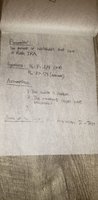
My current work is attached.
I completed part A of the question, but I'm not sure whether its completely correct. I'm also unsure what the third assumption is in part A, or how to do part B. Can you help?
The question:
1) It is estimated that 17.4% of all US households own a Roth IRA. The American Association of University Professors (AAUP) believes this figure is different among their members and commissions a study.
a) If 150 out of a random sample of 750 AAUP members own Roth IRA’s, is this sufficient evidence to support the AAUP belief at the α=0.05 level? (You must run a hypothesis test)
b) Based on your results from (a), if an error was made, would it be type I or type II error? Explain the error you chose in the context of the question.
I completed part A of the question, but I'm not sure whether its completely correct. I'm also unsure what the third assumption is in part A, or how to do part B. Can you help?
The question:
1) It is estimated that 17.4% of all US households own a Roth IRA. The American Association of University Professors (AAUP) believes this figure is different among their members and commissions a study.
a) If 150 out of a random sample of 750 AAUP members own Roth IRA’s, is this sufficient evidence to support the AAUP belief at the α=0.05 level? (You must run a hypothesis test)
b) Based on your results from (a), if an error was made, would it be type I or type II error? Explain the error you chose in the context of the question.