H hurdler New member Joined Sep 7, 2009 Messages 2 Sep 7, 2009 #1 Consider solid obtained by rotating the region bounded by the given curves y=lnx y=3 y=6 x=0 about the y-axis, find the volume of this solid
Consider solid obtained by rotating the region bounded by the given curves y=lnx y=3 y=6 x=0 about the y-axis, find the volume of this solid
D Deleted member 4993 Guest Sep 7, 2009 #2 hurdler said: Consider solid obtained by rotating the region bounded by the given curves y=lnx y=3 y=6 x=0 about the y-axis, find the volume of this solid Click to expand... Draw a sketch of the problem and determine the limits. Decide whether to use disk method or washer method. Please show us your work, indicating exactly where you are stuck - so that we know where to begin to help you.
hurdler said: Consider solid obtained by rotating the region bounded by the given curves y=lnx y=3 y=6 x=0 about the y-axis, find the volume of this solid Click to expand... Draw a sketch of the problem and determine the limits. Decide whether to use disk method or washer method. Please show us your work, indicating exactly where you are stuck - so that we know where to begin to help you.
G galactus Super Moderator Staff member Joined Sep 28, 2005 Messages 7,203 Sep 7, 2009 #3 HINT: It will be easier if you integrate in terms of y and use washers.
H hurdler New member Joined Sep 7, 2009 Messages 2 Sep 7, 2009 #4 I know how to set up the graph and reflect the image but I'm not sure what the washer will look like
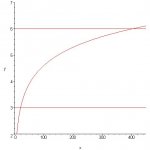
B BigGlenntheHeavy Senior Member Joined Mar 8, 2009 Messages 1,577 Sep 7, 2009 #5 Not a washer, but a disc, observe: \(\displaystyle \pi \int_{3}^{6}(e^{y})^{2}dy \ = \ 255,021 \ cu. \ units.\) Look at graph for further elucidation. [attachment=0:791p2zft]xxx.jpg[/attachment:791p2zft] Attachments xxx.jpg 16 KB · Views: 85
Not a washer, but a disc, observe: \(\displaystyle \pi \int_{3}^{6}(e^{y})^{2}dy \ = \ 255,021 \ cu. \ units.\) Look at graph for further elucidation. [attachment=0:791p2zft]xxx.jpg[/attachment:791p2zft]