Integral - Calculus question

harryyeah

New member
Joined
Nov 13, 2014
Messages
8
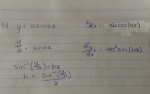
I'm not sure how to tackle this question:An analysis of the motion of a particle resulted in the differential equation d2y/dx2 + b^2*y=0Show that y=asin(bx) is a solution of this equationI've attached some of my workings. Thanks for any help :)
 

Attachments

  • Differentiation_Trig.jpg
    Differentiation_Trig.jpg
    332.9 KB · Views: 5
Last edited by a moderator:
An analysis of the motion of a particle resulted in the differential equation d2y/dx2 + b^2*y=0 Show that y=asin(bx) is a solution of this equationI've attached some of my workings.
You've been given "y=". You've found d2y/dx2 and "b=". What did you get when you plugged these into the given differential equation? If you got "equals zero", then you've done the "showing" part, and you're finished. ;)
 
What was your purpose in solving for "b"? Nothing in the problem asks about "b". You have found y' and y''. Put those expressions, as well as the one you are given for y into the equation and show that it is satisfied.
 
You've been given "y=". You've found d2y/dx2 and "b=". What did you get when you plugged these into the given differential equation? If you got "equals zero", then you've done the "showing" part, and you're finished. ;)

Hey thanks for your reply, I'm not sure I know how to solve the equation once I've plugged in the numbers - so I'm not sure how I can show that it equals zero. Do you know how to solve the equation?

-ab^2sin(bx)+(arcsin(y/a)/x)^2*asin(bx)=0

Thanks again for your help.
 
Did you not read my response? There is no reason in the world to solve for b or replace b with that inverse sine. You have \(\displaystyle y= a sin(bx)\) and you have calculated that \(\displaystyle y''= -ab^2 sin(bx)\). Putting those directly into the equation,
\(\displaystyle y''+ b^2y= -ab^2 sin(bx)+ b^2(a sin(bx))\).
What is that equal to?
 
Did you not read my response? There is no reason in the world to solve for b or replace b with that inverse sine. You have \(\displaystyle y= a sin(bx)\) and you have calculated that \(\displaystyle y''= -ab^2 sin(bx)\). Putting those directly into the equation,
\(\displaystyle y''+ b^2y= -ab^2 sin(bx)+ b^2(a sin(bx))\).
What is that equal to?

Thank you - I'm sorry I did not see your reply. I was overcomplicating things - I appreciate your help :)
 
Top