
integral question for arc length: convert 1 + (x/2-1/(2x))^2 to (x/2+1/(2x))^2

chemENGstudent

New member
Joined
Jul 28, 2016
Messages
2
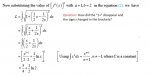
Now substituting the value of [f '(x)]2 with a = 1, b = 2 in the equation (2), we have:

. . . . .\(\displaystyle \begin{align} \displaystyle L\, &=\, \int_1^2\, \sqrt{\strut 1\, +\, \left(\dfrac{1}{2}x\, -\, \dfrac{1}{2x}\right)^2\,}\, dx

\\ \\ &=\, \int_1^2\, \sqrt{\strut \left(\dfrac{x}{2}\, +\, \dfrac{1}{2x}\right)^2\,}\,dx

\\ \\ &=\, \int_1^2\, \left(\dfrac{x}{2}\, +\, \dfrac{1}{2x}\right)\, dx

\\ \\ &=\, \left[\dfrac{x^{1+1}}{2\, \cdot\, 2}\, +\, \dfrac{1}{2}\, \ln(x)\right]_1^2

\\ \\ &=\, \dfrac{3}{4}\, +\, \dfrac{1}{2}\, \ln(2) \end{align}\)


I don't understand how the 1+ disappeared in the square root and the sign changed.

Please help. Thank you!
 

Attachments
  • Calc question.jpg
    Calc question.jpg
    45 KB · Views: 3
Last edited by a moderator:
Help with Arc Length

Now substituting the value of [f '(x)]2 with a = 1, b = 2 in the equation (2), we have:

. . . . .\(\displaystyle \begin{align} \displaystyle L\, &=\, \int_1^2\, \sqrt{\strut 1\, +\, \left(\dfrac{1}{2}x\, -\, \dfrac{1}{2x}\right)^2\,}\, dx

\\ \\ &=\, \int_1^2\, \sqrt{\strut \left(\dfrac{x}{2}\, +\, \dfrac{1}{2x}\right)^2\,}\,dx

\\ \\ &=\, \int_1^2\, \left(\dfrac{x}{2}\, +\, \dfrac{1}{2x}\right)\, dx

\\ \\ &=\, \left[\dfrac{x^{1+1}}{2\, \cdot\, 2}\, +\, \dfrac{1}{2}\, \ln(x)\right]_1^2

\\ \\ &=\, \dfrac{3}{4}\, +\, \dfrac{1}{2}\, \ln(2) \end{align}\)


I don't understand how the 1+ disappeared in the square root and the sign changed.

Please help. Thank you!
 
Last edited by a moderator:
Now substituting the value of [f '(x)]2 with a = 1, b = 2 in the equation (2), we have:

. . . . .\(\displaystyle \begin{align} \displaystyle L\, &=\, \int_1^2\, \sqrt{\strut 1\, +\, \left(\dfrac{1}{2}x\, -\, \dfrac{1}{2x}\right)^2\,}\, dx

\\ \\ &=\, \int_1^2\, \sqrt{\strut \left(\dfrac{x}{2}\, +\, \dfrac{1}{2x}\right)^2\,}\,dx

\\ \\ &=\, \int_1^2\, \left(\dfrac{x}{2}\, +\, \dfrac{1}{2x}\right)\, dx

\\ \\ &=\, \left[\dfrac{x^{1+1}}{2\, \cdot\, 2}\, +\, \dfrac{1}{2}\, \ln(x)\right]_1^2

\\ \\ &=\, \dfrac{3}{4}\, +\, \dfrac{1}{2}\, \ln(2) \end{align}\)


I don't understand how the 1+ disappeared in the square root and the sign changed.
What did you get when you applied what you learned back in algebra, and you expanded the integrand and simplified? You started with:

. . . . .\(\displaystyle 1\, +\, \left(\dfrac{1}{2}x\, -\, \dfrac{1}{2x}\right)^2\)

You expanded:

. . . . .\(\displaystyle 1\, +\, \dfrac{1}{4}x^2\, -\, 2\, \cdot\, \left(\dfrac{1}{2}x\right)\, \left(\dfrac{1}{2x}\right)\, +\, \dfrac{1}{4x^2}\)

. . . . .\(\displaystyle 1\, +\, \dfrac{1}{4}x^2\, -\, \dfrac{1}{2}\, +\, \dfrac{1}{4x^2}\)

. . . . .\(\displaystyle \dfrac{1}{4}x^2\, +\, \dfrac{1}{2}\, +\, \dfrac{1}{4x^2}\)

...and... then what?

Please be complete. Thank you! ;)
 
Top