
You are using an out of date browser. It may not display this or other websites correctly.
You should upgrade or use an alternative browser.
You should upgrade or use an alternative browser.
Integral with partial frac.
- Thread starter hrr379
- Start date
D
Deleted member 4993
Guest
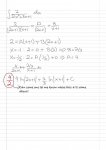
I know I am doing this wrong. If some one be so kind to point out where I am going wrong?
\(\displaystyle \dfrac{d}{dx}\left [ln|2x+1|\right ] \ = \ \dfrac{1}{2x+1} \ * \ \dfrac{d}{dx}\left [2x+1\right ] \ = \ ??? \)
Hello, hrr379!
Your partial fractions are incorrect . . .
\(\displaystyle \displaystyle\frac{2}{(2x+1)(x+1)} \;=\;\frac{A}{2x+1} + \frac{B}{x+1}\)
. . . . . .\(\displaystyle 2 \;=\;A(x+1) + B(2x+1)\)
\(\displaystyle x = \text{-}1\!:\quad \overbrace{2 \;=\;B(\text{-}1)}^{\text{Here!}} \quad\Rightarrow\quad B = \text{-}2\)
\(\displaystyle x = \text{-}\frac{1}{2}\!: \quad 2 \;=\;A(\frac{1}{2}) \quad\Rightarrow\quad A = 4\)
\(\displaystyle \displaystyle\text{Therefore: }\:\frac{2}{(2x+1)(x+1)} \;=\;\frac{4}{2x+1} - \frac{2}{x+1}\)
~ ~ ~ ~ ~ ~ ~ ~ ~ ~ ~ ~ ~ ~ ~ ~ ~ ~ ~ ~ ~ ~ ~ ~ ~ ~ ~
Always check your partial fractions before proceeding . . .
\(\displaystyle \displaystyle \frac{4}{2x+1} - \frac{2}{x+1} \;=\; \frac{4(x+1) - 2(2x+1)}{(2x+1)(x+1)} \)
. . . . . . . . . . . . . .\(\displaystyle \displaystyle=\;\frac{4x+4 - 4x - 2}{(2x+1)(x+1)} \;=\;\frac{2}{(2x+1)(x+1)} \)
. . . . . See?
Your partial fractions are incorrect . . .
I know I am doing this wrong.
If someone be so kind to point out where I am going wrong?
. . \(\displaystyle \displaystyle\int\frac{2}{2x^2+3x+1}\,dx\)
\(\displaystyle \displaystyle\frac{2}{(2x+1)(x+1)} \;=\;\frac{A}{2x+1} + \frac{B}{x+1}\)
. . . . . .\(\displaystyle 2 \;=\;A(x+1) + B(2x+1)\)
\(\displaystyle x = \text{-}1\!:\quad \overbrace{2 \;=\;B(\text{-}1)}^{\text{Here!}} \quad\Rightarrow\quad B = \text{-}2\)
\(\displaystyle x = \text{-}\frac{1}{2}\!: \quad 2 \;=\;A(\frac{1}{2}) \quad\Rightarrow\quad A = 4\)
\(\displaystyle \displaystyle\text{Therefore: }\:\frac{2}{(2x+1)(x+1)} \;=\;\frac{4}{2x+1} - \frac{2}{x+1}\)
~ ~ ~ ~ ~ ~ ~ ~ ~ ~ ~ ~ ~ ~ ~ ~ ~ ~ ~ ~ ~ ~ ~ ~ ~ ~ ~
Always check your partial fractions before proceeding . . .
\(\displaystyle \displaystyle \frac{4}{2x+1} - \frac{2}{x+1} \;=\; \frac{4(x+1) - 2(2x+1)}{(2x+1)(x+1)} \)
. . . . . . . . . . . . . .\(\displaystyle \displaystyle=\;\frac{4x+4 - 4x - 2}{(2x+1)(x+1)} \;=\;\frac{2}{(2x+1)(x+1)} \)
. . . . . See?