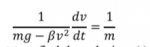
\(\displaystyle \Large{ \dfrac{1}{mg\, -\, \beta v^2}\, \dfrac{dv}{dt}\, =\, \dfrac{1}{m} }\)
How can I integrate the above equation with respect to t? Thanks
Are we supposed to assume that only "v" depends on "t", so the other variables are actually constants? Are we supposed to assume that you're integrating "v" with respect to "t"?
What did you try? For instance, did you start with something like one of the following?
. . . . .\(\displaystyle \mbox{a. }\, \begin{align} \dfrac{1}{mg\, -\, \beta v^2}\, \dfrac{dv}{dt}\, &=\, \dfrac{1}{m}
\\ \dfrac{1}{mg\, -\, \beta v^2}\, dv\, &=\, \dfrac{1}{m}\, dt \end{align}\)
...or:
. . . . .\(\displaystyle \mbox{b. }\, \begin{align} \dfrac{1}{mg\, -\, \beta v^2}\, \dfrac{dv}{dt}\, &=\, \dfrac{1}{m}
\\ \dfrac{dv}{dt}\, &=\, \dfrac{mg\, -\, \beta v^2}{m} \end{align}\)
If one of the above, which? And what did you do next? If not, what
did you try?
Please be complete. Thank you!