
integration: area in Q1 between curves y = x^2, y-axis, y = 1, and y = 9

markosheehan

New member
Joined
May 12, 2016
Messages
31
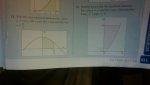
15. Find the area in the first quadrant between the curve y = x 2 and the y -axis, between the lines y = 1 and y = 9.

can some one help me with question 15. i am integrating it and trying this 1/3 (9)^3 -(1/3 (1)^3) and this gives me a answer of 242.66667 but the answer at the back of the book is 17 2/3.
 

Attachments
  • WIN_20160912_17_34_14_Pro.jpg
    WIN_20160912_17_34_14_Pro.jpg
    107.2 KB · Views: 7
Last edited by a moderator:
attachment.php


can some one help me with question 15. i am integrating it and trying this 1/3 (9)^3 -(1/3 (1)^3) and this gives me a answer of 242.66667 but the answer at the back of the book is 17 2/3.

Try \(\displaystyle \large 8 +\displaystyle \int_1^3 {(9 - {x^2})dx}\)
 
15. Find the area in the first quadrant between the curve y = x 2 and the y -axis, between the lines y = 1 and y = 9.

can some one help me with question 15. i am integrating it and trying this 1/3 (9)^3 -(1/3 (1)^3) and this gives me a answer of 242.66667 but the answer at the back of the book is 17 2/3.
Where does the line y = x^2 intersect with the line y = 1? What is the x-value for this intersection point?

Before this intersection point, the area is just a rectangle. What is the area of this rectangle?

Where does the line y = x^2 intersect with the line y = 9? What is the x-value for this intersection point?

Between the two intersection points, what is the top curve? What is it's equation? (Hint: It's just a number.) What is the bottom curve? What subtraction creates the equation for the height of the area? What integral then do you get?

If you get stuck, please reply showing your steps so far. Thank you! ;)
 
15. Find the area in the first quadrant between the curve y = x 2 and the y -axis, between the lines y = 1 and y = 9.

can some one help me with question 15. i am integrating it and trying this 1/3 (9)^3 -(1/3 (1)^3) and this gives me a answer of 242.66667 but the answer at the back of the book is 17 2/3.
Another way: Think of this in terms of inverse functions, i.e.
x = f(y) = \(\displaystyle \sqrt{y}\)
since we want the first quadrant. Thus the area is just the integral
A = \(\displaystyle \int_1^9\, f(y)\, dy\)

Can you continue from there? If not, show your work and we will help you.

BTW: I think I get 17 1/3, but I was working kind of fast so maybe not.
 
Top