Integration by substitution

Anthonyk2013

Junior Member
Joined
Sep 15, 2013
Messages
132
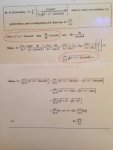
In the question in the image U=a^2+X^2-2axcos0 how does du/d0 become 2axsin0.
Please excuse 0 used for theta.

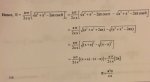
Also when a^2+X^2-2axcos0 is substituted back there is a sign change. Is this a typo or right?
 

Attachments

  • image.jpg
    image.jpg
    10.2 KB · Views: 5
I'm sorry, but that image is very small and I can't make out anything it says. Can you please post a clearer image or type out the text of the problem? Thank you.
 
Apologies hope these are better.
 

Attachments

  • image.jpg
    image.jpg
    23.4 KB · Views: 2
  • image.jpg
    image.jpg
    16.3 KB · Views: 2
In the question in the image U=a^2+X^2-2axcos0 how does du/d0 become 2axsin0.
Please excuse 0 used for theta.

Also when a^2+X^2-2axcos0 is substituted back there is a sign change. Is this a typo or right?
The use of 0 for theta is perfectly fine as long as you say what you are doing. In the equation maybe this would make it clearer (I assume the x and X are the same)
U(0) = a2 + x2 - 2 a x cos0
Thus, since a and x are not functions of theta, they are treated as constants and their derivatives are zero. The derivative of cos(0) is -sin(0).

As far as the other question, I'm not sure what you mean unless it is where you end up with the part that looks like
\(\displaystyle \sqrt{a^2\, +\, x^2\, -\, 2\, a\, x\, cos(\pi)}\, -\, \sqrt{a^2\, +\, x^2\, -\, 2\, a\, x\, cos(0)}\)
= \(\displaystyle \sqrt{a^2\, +\, x^2\, +\, 2\, a\, x}\, -\, \sqrt{a^2\, +\, x^2\, -\, 2\, a\, x}\)
and that is just the evaluation of \(\displaystyle cos(\pi)\, =\, -1\, and\, cos(0)\, =\, 1\)

EDIT: BTW: you need to be careful with that \(\displaystyle \sqrt{(x-a)^2}\, =\, x\, -\, a\) and similarly with the other square root. Technically \(\displaystyle \sqrt{(x-a)^2}\, =\, |x\, -\, a|\) so the assumption in the problem is that x \(\displaystyle \ge\) |a|.

 
Last edited:
The use of 0 for theta is perfectly fine as long as you say what you are doing. In the equation maybe this would make it clearer (I assume the x and X are the same)
U(0) = a2 + x2 - 2 a x cos0
Thus, since a and x are not functions of theta, they are treated as constants and their derivatives are zero. The derivative of cos(0) is -sin(0).

As far as the other question, I'm not sure what you mean unless it is where you end up with the part that looks like
\(\displaystyle \sqrt{a^2\, +\, x^2\, -\, 2\, a\, x\, cos(\pi)}\, -\, \sqrt{a^2\, +\, x^2\, -\, 2\, a\, x\, cos(0)}\)
= \(\displaystyle \sqrt{a^2\, +\, x^2\, +\, 2\, a\, x}\, -\, \sqrt{a^2\, +\, x^2\, -\, 2\, a\, x}\)
and that is just the evaluation of \(\displaystyle cos(\pi)\, =\, -1\, and\, cos(0)\, =\, 1\)

EDIT: BTW: you need to be careful with that \(\displaystyle \sqrt{(x-a)^2}\, =\, x\, -\, a\) and similarly with the other square root. Technically \(\displaystyle \sqrt{(x-a)^2}\, =\, |x\, -\, a|\) so the assumption in the problem is that x \(\displaystyle \ge\) |a|.

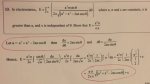
At the very start of the question at the top of the page a^2-X^2-2axcos0 but when it's substituted back in its U=a^2+X^2-2axcos0

should it be U=a^2-X^2-2axcos0
 
Last edited:
At the very start of the question at the top of the page a^2-X^2-2axcos0 but when it's substituted back in its U=a^2+X^2-2axcos0

should it be U=a^2-X^2-2axcos0

I strongly suspect the a^2-X^2-2axcos0 is a typo and it should be a^2+X^2-2axcos0.
 
Top