
Intergral of Velocity help plz

lsidohl

New member
Joined
Dec 15, 2013
Messages
4
I have been given this question to answer and im not sure how to go about doing it.

Let s(t) be the position, in metres, of a car along a straight east/west highway at time t
seconds. Positive values of s indicate eastward displacement of the car from home, and
negative values indicate westward displacement. Let v(t) represent the velocity of the
car, in m/sec, at time t seconds.

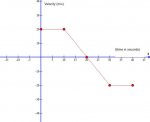
xs86NailABxJnVJKECiDOrSUIFEGdWk4QKIM6sJgkVQJxZTRIqgDizmiRUAHFmNUmoAOLMapJQAcSZ1SShAogzq0lCBRBnVpOECiDOrCYJFUCcWU0SKoA4s5okVABxZjVJqADizGqSUAHEmdUkoQKIM6tJQgUQZ1aThAogzqwmCRVAnFlNEiqAOLOaJFQAcWY1SagA4sxqklABxJnVJKECiDOrSUIFEGdWk4QKIM6sJgkVQJxZTRIqgDizmiRUAHFmNUmoAOLMapJQAcSZ1SShAoj7H5XW5FDnVrN2AAAAAElFTkSuQmCC
graph.jpg

I need to fill in the following chart for s(t)

t 0 10 20 30 40
s(t)


from this information i need to work out

Integral of velocity
10
f v(t) dt =
0


and change in position

s(10)-s(0) =


There is more questions i just really need a practical answer to see how its done then i should be right.
 
Last edited:
I have been given this question to answer and im not sure how to go about doing it.

Let s(t) be the position, in metres, of a car along a straight east/west highway at time t
seconds. Positive values of s indicate eastward displacement of the car from home, and
negative values indicate westward displacement. Let v(t) represent the velocity of the
car, in m/sec, at time t seconds.


t 0 10 20 30 40
s(t) 20 20 0 -20 -20


from this information i need to work out

Integral of velocity
10
f v(t) dt =
0


and change in position

s(10)-s(0) =


There is more questions i just really need a practical answer to see how its done then i should be right.
Is this ALL the information given?

Did you graph position on the vertical axis against time on the horizontal axis?

What is the definition of average velocity?

What is a piecewise function?
 
I Have put the graph needed to work out the question on now, your help would be greatly appreciated :)
 
I Have put the graph needed to work out the question on now, your help would be greatly appreciated :)
The definition of average velocity = \(\displaystyle \dfrac{\Delta s}{\Delta d}.\)

What does \(\displaystyle \dfrac{s(10) - s(0)}{10 - 0}\ equal?\)

So what is velocity in terms of t for \(\displaystyle 0 \le t \le 10?\)
 
One typically learns "integrals", initially, in terms of "area under the curve". Do you not see that the areas under this curve can be done in terms of triangles and rectangles?
 
Yeah I just dont know how to start the question I understand the concept I just need one done as a practical example for me to visualize
 
Yeah I just dont know how to start the question I understand the concept I just need one done as a practical example for me to visualize
To get the "area under the curve" of velocity, you first have to get a curve for velocity, which you have not yet done.

I explained above what the definition of average velocity was? Did you do the indicated computation? What did you get? So what is the average velocity? Now graph THAT.

Once you show that graph, you may be able to answer the question on your own. If not, show the graph and say what seems mysterious to you about finding the "area under the curve."
 
Let s(t) be the position, in metres, of a car along a straight east/west highway at time t seconds. Positive values of s indicate eastward displacement of the car from home, and negative values indicate westward displacement. Let v(t) represent the velocity of the car, in m/sec, at time t seconds.

xs86NailABxJnVJKECiDOrSUIFEGdWk4QKIM6sJgkVQJxZTRIqgDizmiRUAHFmNUmoAOLMapJQAcSZ1SShAogzq0lCBRBnVpOECiDOrCYJFUCcWU0SKoA4s5okVABxZjVJqADizGqSUAHEmdUkoQKIM6tJQgUQZ1aThAogzqwmCRVAnFlNEiqAOLOaJFQAcWY1SagA4sxqklABxJnVJKECiDOrSUIFEGdWk4QKIM6sJgkVQJxZTRIqgDizmiRUAHFmNUmoAOLMapJQAcSZ1SShAoj7H5XW5FDnVrN2AAAAAElFTkSuQmCC
View attachment 3529

I need to fill in the following chart for s(t)

t 0 10 20 30 40
s(t)
You say (elsewhere) that you understand that the position is the integral of the velocity (which is graphed above) and that the integral is the area. So find the area, from t = 0 to t = (whatever), from the graph above. You can use simple area-of-rectangle and area-of-triangle formulas from geometry. For instance, s(10) is the (oositive) area (because it's above the x-axis), from t = 0 to t = 10, of the rectangle which is ten units wide and, from the y-axis, twenty units high. What is that area? And so forth.

this information i need to work out

Integral of velocity
10
f v(t) dt =
0

and change in position s(10)-s(0) =
So apply the definitions you've been given, sum up the rectangle and triangle areas, and interpret the results. ;)
 
Last edited:
Yeah I just dont know how to start the question I understand the concept I just need one done as a practical example for me to visualize
In the future, please do not ask question in private messages. That means that other students cannot see the whole thread. In any case, you are given times and the velocities (I think that differs from your original post that you have since edited.)

\(\displaystyle t\ \ \ \ \ \ \ \ \ \ v(t)\)

\(\displaystyle 0\ \ \ \ \ \ \ \ \ \ 20\)

\(\displaystyle 10\ \ \ \ \ \ \ \ 20\)

\(\displaystyle 20\ \ \ \ \ \ \ \ \ 0\)

\(\displaystyle 30\ \ -20\)

\(\displaystyle 40\ \ -20\)

Now as Halls explained, the integral equals the area under the curve.

So for any period between 0 and 10 seconds, the velocity is constant, and the area beneath the curve is a rectangle with area of
t * v(t) = s. You learned this way back in first year algebra as r * t = d, which is true if velocity is constant.

Are you with me so far? So if you travel at a constant speed of 20 m/s for 10 seconds how far do you go? So what is your position? Do you see that equals the area under the curve from 0 to 10 seconds.

Now from 10 seconds to 20 seconds, your velocity is slowing down steadily. Do you see that from your graph? OK. What is your average velocity if your velocity is slowing at a steady a pace from 20 to 0? In the 10 seconds from 10 to 20, how much further do you travel? Do you see that equals the area of the triangle from 10 to 20? Now your position after 20 seconds is the sum of what?

See how far you get with this further hint: if the curve is BELOW the horizontal axis, the area is considered negative in value.
 
Top