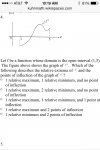
The entire problem is in the image attached to this post. Apparently the answer is E, but I don't see how there can be two points of inflection if the graph of f'' only changes sign once! Any help or explanation would be greatly appreciated.
The entire problem is in the image attached to this post. Apparently the answer is E, but I don't see how there can be two points of inflection if the graph of f'' only changes sign once! Any help or explanation would be greatly appreciated.
First, note that the question is about \(\displaystyle f'\text{ NOT }f~.\)
The graph is of \(\displaystyle f''\) the derivative of \(\displaystyle f'~.\)
Because the graph is zero at only one point, that means \(\displaystyle f'\) has only one relative extreme.
Since the graph goes from negative to positive there the point is a minimum.
The graph has two horizontal tangents. So \(\displaystyle f'\) has two points of inflection.
This site uses cookies to help personalise content, tailor your experience and to keep you logged in if you register.
By continuing to use this site, you are consenting to our use of cookies.